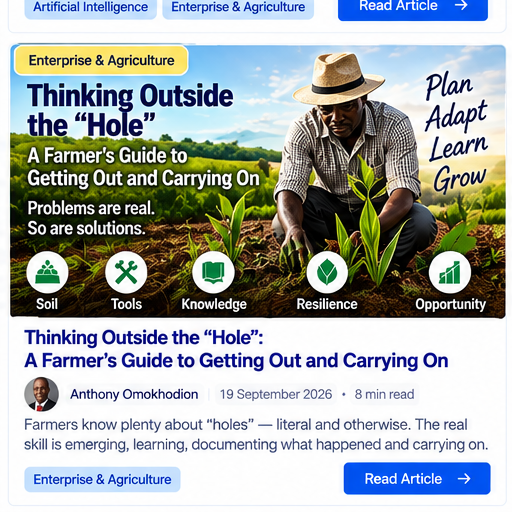
Farmers know a thing or two about “holes.”
Some are literal. We dig them for drainage, planting, fencing, irrigation and foundations. Others arrive without a shovel: failed crops, broken equipment, rising feed prices, collapsing markets, unreliable power, unexpected weather and experiments that simply refuse to behave as planned.
And then there are the digital “holes.”
A tool reaches its quota. A connector refuses to connect. A service tells you to wait. A perfectly sensible workflow suddenly discovers a perfectly nonsensical obstacle.
The temptation is to make the obstacle the story.
Farmers cannot afford that luxury.
The “Hole” Is Not the Destination
When something fails on a farm, the objective does not disappear. If irrigation stops, the crop still needs water. If a machine breaks, the work still needs doing. If a market collapses, the harvest still exists.
The question changes from “Why has this happened?” to “What gets us moving again?”
The objective is not to become better at sitting in the “hole.” It is to remember where you were trying to go before you fell into it.
Change the Route, Not the Objective
This is one of farming’s most transferable lessons. A blocked route is not necessarily a blocked destination.
- If one growing method fails, test another.
- If fresh produce cannot reach the market in time, investigate preservation or processing.
- If an input becomes too expensive, ask what can be produced, substituted or redesigned locally.
- If technology imposes an artificial limit, look for another responsible route to the same outcome.
Persistence is not repeatedly hitting the same wall. Sometimes persistence means having enough clarity about the objective to abandon the wall altogether.
But Climbing Out Is Only Half the Job
A person can escape a “hole” and learn something. An institution should do more.
Record where the “hole” was. Record how we got into it. Record what warning signs we missed. Record what we tried, what failed, what eventually worked and what the next person should know.
That is how failure begins to become institutional memory.
If Anthony remembers why an experiment failed, Anthony possesses knowledge. If Excell documents the experiment, reasoning, result and correction so that somebody can retrieve it years later, Excell remembers.
Farmers Are Professional Emergers
Perhaps this is why farmers develop a peculiar relationship with setbacks. Agriculture constantly reminds us that control is partial. Weather changes. Animals surprise us. Markets move. Machines fail. Plants ignore PowerPoint presentations.
Yet tomorrow morning still arrives.
You inspect. You adjust. You repair. You replant. You measure. You try again.
Not because every problem is trivial, and certainly not because every loss can be recovered, but because productive systems are built through adaptation.
So Think Outside the “Hole”
“Think outside the box” has become such a familiar expression that we barely hear it anymore.
Farmers may need a different version.
Sometimes innovation isn’t thinking outside the box. Sometimes it’s simply thinking your way out of the “hole.”
Then, once you are out, mark the location.
Write down what happened.
Teach somebody else.
And build the system so the next generation does not have to fall into exactly the same “hole” to learn exactly the same lesson.
JustLearn.