Sometimes a photograph tells you where a journey has reached. A certificate tells you how far it has travelled.
Excell Africa Farms was built around a deceptively simple proposition: an African farm does not have to end at the farm gate.
It can grow food. It can create employment. It can teach. It can experiment. It can process what it grows. It can create products. It can tell stories. And, with today’s technology and global connections, it can reach communities thousands of miles from the soil in which its crops were planted.
That journey received a particularly meaningful acknowledgement in Milton Keynes.
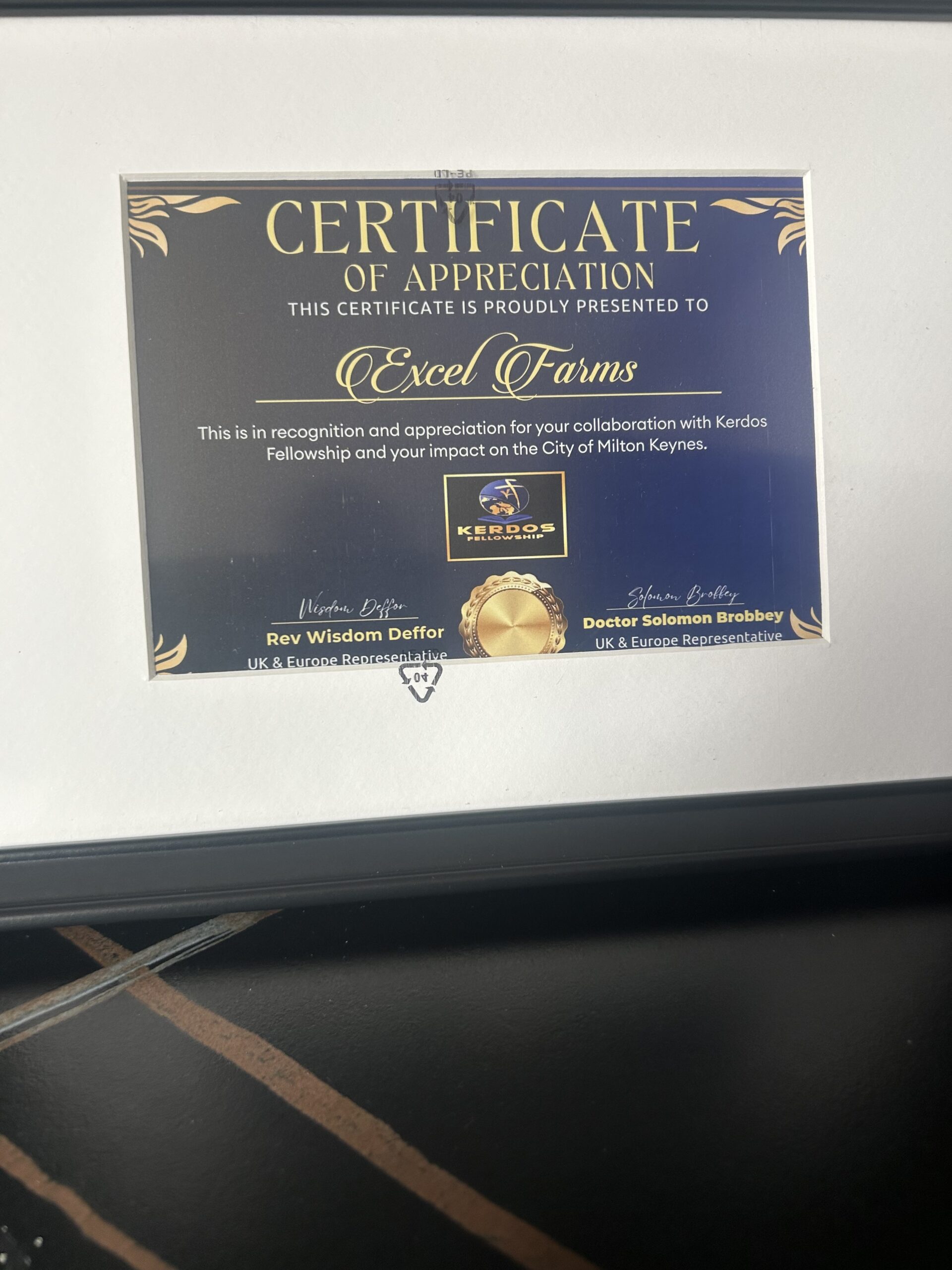
Excell Farms was presented with a Certificate of Appreciation from Kerdos Fellowship, recognising its collaboration with the Fellowship and, in the precise words printed on the certificate, its “impact on the City of Milton Keynes.”
For us, those words are significant.
Because the farm isn’t in Milton Keynes.
The farm is in Africa.
I Live in Britain. I Farm in Africa.
People sometimes find that statement surprising.
When I am asked in Britain what I do, one of my standard answers is very simple: “I’m a farmer.”
The almost inevitable question is: “Where? Here in England?”
No. I live in Britain. I farm in Africa.
Excell Africa Farms operates from Africa, including our work in Wasinmi, Ogun State, Nigeria, and Mondouku in Côte d’Ivoire.
But increasingly, I have come to believe that the physical location of a business tells us only part of the story. A farm can be in Africa while its knowledge travels to Britain. Its products can travel. Its ideas can travel. Its educational content can travel. Its relationships can travel. And ultimately, its impact can travel.
The certificate presented in Milton Keynes is a small but tangible illustration of that principle.
The Farm Is Becoming More Than a Farm
This has also been one of the great lessons of our journey. We grow crops and raise livestock, certainly. But the knowledge generated by doing those things has become an asset in its own right.
A batch of chicks becomes an experiment. An experiment becomes a lesson. A lesson becomes an article. An article can become a video, podcast, masterclass or chapter in a book. A crop can become a processed product. A problem on the farm can become the starting point for an engineering solution.
And a relationship created around one of those activities can eventually connect a farm in Africa with a community in Milton Keynes.
That is why I increasingly resist the idea that African agriculture should be viewed simply as the production of commodities. The farmer does not have to sell only what grows from the soil.
The farmer can also create value through knowledge, processing, education, experience, intellectual property, technology and access to markets.
Africa and Britain Don’t Have to Be Competing Choices
Too often, discussions about African entrepreneurship are framed as a choice: Africa or Britain. Local or international. Rural or urban. Agriculture or technology.
I increasingly think those distinctions belong to an older economic model.
I can live in Britain and farm in Africa. We can produce in Africa and create relationships in Britain. We can employ people locally while accessing knowledge and markets globally. We can use artificial intelligence, digital publishing, online education and modern communications to reduce some of the disadvantages that geography once imposed on a small African enterprise.
The internet did not move our farm. It changed what being far away means.
From Soil to Significance
Our theme at Excell Africa Farms has been From Soil to Significance. The phrase was never intended to mean simply becoming bigger. Significance is different from size.
A five-acre farm can matter. One employee whose income supports a household matters. One student who discovers that agriculture can be a serious career matters. One experiment that prevents another farmer from repeating an expensive mistake matters. One African product reaching a customer abroad matters.
And one relationship between an African agricultural enterprise and a community organisation in a British city matters.
That is how institutions begin: not necessarily with enormous buildings or enormous capital, but with useful things done repeatedly until people begin to notice that something valuable is being built.
A Certificate — and a Responsibility
We therefore receive this Certificate of Appreciation with gratitude. But I don’t regard it merely as something to hang on a wall. It is also a reminder.
If an organisation in Milton Keynes can see value in collaborating with an African farming enterprise, then we should ask ourselves a bigger question: How much further can this model travel?
Could African farms supply specialist products to diaspora communities? Could practical farming experience become internationally accessible agricultural education? Could young Africans learn modern agriculture while participating in enterprises already connected to international markets? Could relatively small rural businesses use AI, renewable energy, digital commerce and distributed logistics to participate directly in the global economy?
Those are much bigger questions than a certificate can answer. But perhaps the certificate represents something else: evidence that the journey has already begun.
Thank You, Kerdos Fellowship
We thank Kerdos Fellowship for the recognition and, more importantly, for the collaboration that made the recognition possible.
The certificate records appreciation for Excell Farms’ “impact on the City of Milton Keynes.” We accept those words with gratitude — and with a determination to keep building.
Because somewhere between a farm in Africa and a city in England lies the model we are trying to build.
Grow locally. Learn constantly. Connect globally. Create impact wherever you can.
That is what From Soil to Significance means to us.
Continue the Journey
Excell Africa Farms documents practical farming, enterprise experiments and the lessons emerging from our work in Africa. Explore more articles on JustLearn and follow the continuing From Soil to Significance journey.
Learn from the farm. Build from experience. Turn knowledge into enterprise.