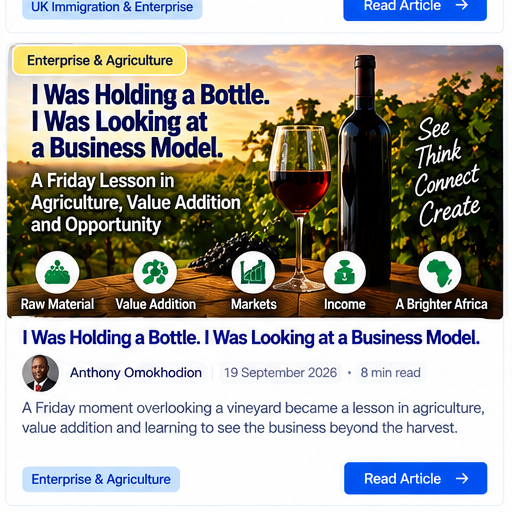
It was Friday. I was standing overlooking a vineyard, bottle in one hand and glass in the other.
Most people looking at the photograph will probably see a man enjoying the end of the week. I saw something else. I saw agriculture.
More importantly, I saw what happens when agriculture refuses to stop at the farm gate.
Before the Bottle, There Was a Plant
The polished bottle is the end of a much longer story. Before the label, the glass and the finished product, there was land. There were vines. There was planting, pruning, weather, labour, waiting and harvesting.
Value addition has not replaced farming. It depends upon production. There can be no bottle without the crop. But production does not have to be where the economic story ends.
The Farmer Who Sells Only the Harvest Leaves Money Behind
A vineyard can produce grapes. Around those grapes an entire value chain can develop: processing, bottling, packaging, branding, distribution, hospitality, tourism, education and experiences.
The agricultural product moves from being something merely harvested to something presented, remembered and valued.
What Does This Mean for African Agriculture?
Consider the crops and products around us every day. Pepper does not have to end as fresh pepper at the market. It can be dried, milled, blended, packaged and branded.
Moringa does not have to end as leaves on a tree. It can become dried leaf, powder, tea ingredients, seed products and oil, subject to appropriate food, cosmetic and regulatory requirements.
Cassava does not have to end as tubers. Livestock does not have to end with the sale of a live animal. Fruit does not have to end with the fresh harvest.
The question is not simply, What can I grow? The more powerful question is: What can this become?
The Farm Can Become the Factory, Classroom and Destination
This is one of the ideas we are exploring at Excell Africa Farms. A farm can be a place of production, but it can also become a laboratory for processing, a classroom for practical learning, a demonstration centre for technology and a source of stories and knowledge.
A pepper harvest can become a lesson in preservation when prices collapse. A moringa plantation can become a study in processing and product development. A greenhouse can become both a production system and a teaching environment.
None of this diminishes the importance of growing food. It makes production more valuable because we begin designing what happens after the harvest.
Learn to See the Bottle While You Are Planting the Seed
There is an entrepreneurial discipline in looking beyond the raw material.
When planting, we should already be thinking about storage. When producing, we should be thinking about processing. When processing, we should be thinking about packaging. When packaging, we should be thinking about customers, distribution and brand.
Not every farmer needs to own every stage of the value chain. Partnerships and specialist businesses matter. But every serious agricultural entrepreneur should understand the chain in which the farm operates.
That Friday, I raised a glass.
But perhaps the more important thing was what stood behind me.
Acres of plants.
Because before there was a beautifully labelled bottle, there was agriculture.
And somewhere in Africa today, a farmer may be standing beside the raw material for a business they have not yet learned to see.
JustLearn.