Solar greenhouse lighting can have a very practical purpose: letting us inspect the crop after sunset. The aim is not to keep either plants or people working all night. It is to make a useful observation possible at the right time.
Our night-time greenhouse photographs show an illuminated walkway, climbing foliage, hanging plant supports and a close inspection of the plants. The lights are solar-powered. But the most interesting part of the scene is not the electricity.
It is the opportunity to look.
At Excell Africa Farms, this is the kind of question we want technology to answer: what useful task does it make possible, and what do we learn from doing that task?
The sun has gone down. The learning has not.
In our earlier account of Igbo egusi climbing into the greenhouse roof, the lesson began when somebody looked upwards. This time, the question is not simply where we look. It is when we look.
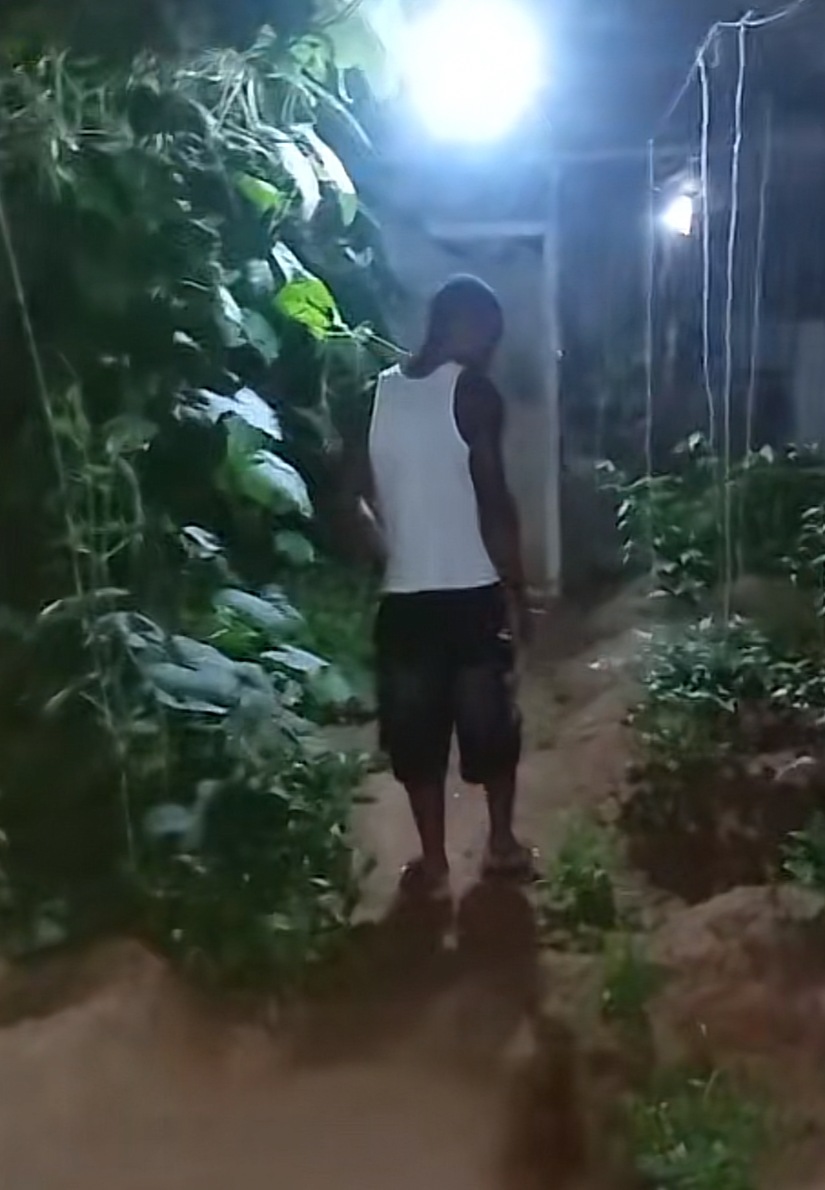
1. What can a greenhouse reveal after dark?
An evening inspection is not automatically better than a daytime inspection. It can, however, offer a different opportunity to investigate.
Snails and slugs commonly feed at night and hide during the day. The University of California’s Integrated Pest Management guidance recommends looking at night or early in the morning when investigating their activity. It also warns that holes in leaves can have other causes.
That is an important distinction. A damaged leaf is a reason to investigate, not proof that we have identified the culprit. These photographs do not establish that snails, slugs or any particular pest are present in our greenhouse.
A useful inspection also needs to go beyond admiring the overall canopy. Oklahoma State University’s greenhouse scouting guidance recommends examining plants from older leaves through to new growth, including leaf undersides, buds and flowers. Pest problems are not necessarily distributed evenly across the crop, so one healthy-looking plant cannot speak for every bed.
For our team, the practical question becomes: can we describe what we actually inspected? A short round with a clear purpose is more useful than walking through the greenhouse and declaring that everything looks green.
Night-time observation should complement daylight checks. Where an evening photograph is too blurred to support identification, mark the location and return for a clearer examination rather than turning uncertainty into a diagnosis.
2. Solar power buys flexibility, not unlimited free electricity
The value of these lights is easy to understand: the inspection no longer has to finish simply because daylight has finished.
There is nevertheless an engineering distinction worth preserving. Solar panels do not generate their daytime output after sunset. Night-time use of solar electricity normally depends on energy stored earlier, commonly in batteries. The US Department of Energy explains how storage separates the time of generation from the time of use, while noting that storage involves energy losses.
That battery might be part of an individual light or part of a wider farm system. The photographs do not establish the arrangement, battery chemistry, lamp rating or runtime here. Nor do they demonstrate a battery-free system.
For illustration only, two lamps actually drawing 10 watts each for one hour would use 20 watt-hours at the lamps. Running those same lamps for eight hours would use 160 watt-hours, before allowing for other system consumption and losses. These are example calculations, not measurements of the equipment shown.
For our own evaluation, I would record the purchase and installation cost, maintenance, actual lighting time and the work completed during that time. I would also ask whether the evening round produced an observation that warranted follow-up.
That is a proposal for measuring value, not a claim that these lights have already delivered a particular financial return.
The useful question is not only how brightly a light shines. It is what the farm can do with the visibility it provides.
3. Work lights are not automatically grow lights
A greenhouse illuminated at night can look like a controlled crop-lighting installation. The appearance alone does not establish that it is one.
Horticultural lighting has distinct purposes. Supplemental lighting adds photosynthetic light, while photoperiodic lighting changes the light-and-dark schedule perceived by responsive plants. The University of Massachusetts explains that photoperiodic responses can occur under much lower light intensity than that used for supplemental lighting.
This means that a lamp need not provide a substantial growth benefit to affect the flowering schedule of a sensitive crop. Whether an effect occurs depends on the plant and the lighting conditions; we cannot determine it from these screenshots.
My management starting point for an inspection-led system would therefore be to use lighting for the task rather than automatically leaving the entire greenhouse illuminated throughout the night. Before making repeated night lighting routine, check the requirements of the crops being grown.
We should not sell this story as proof that our plants grow faster because the lights are on. The benefit visible here is much simpler: someone can see the plants well enough to examine them.
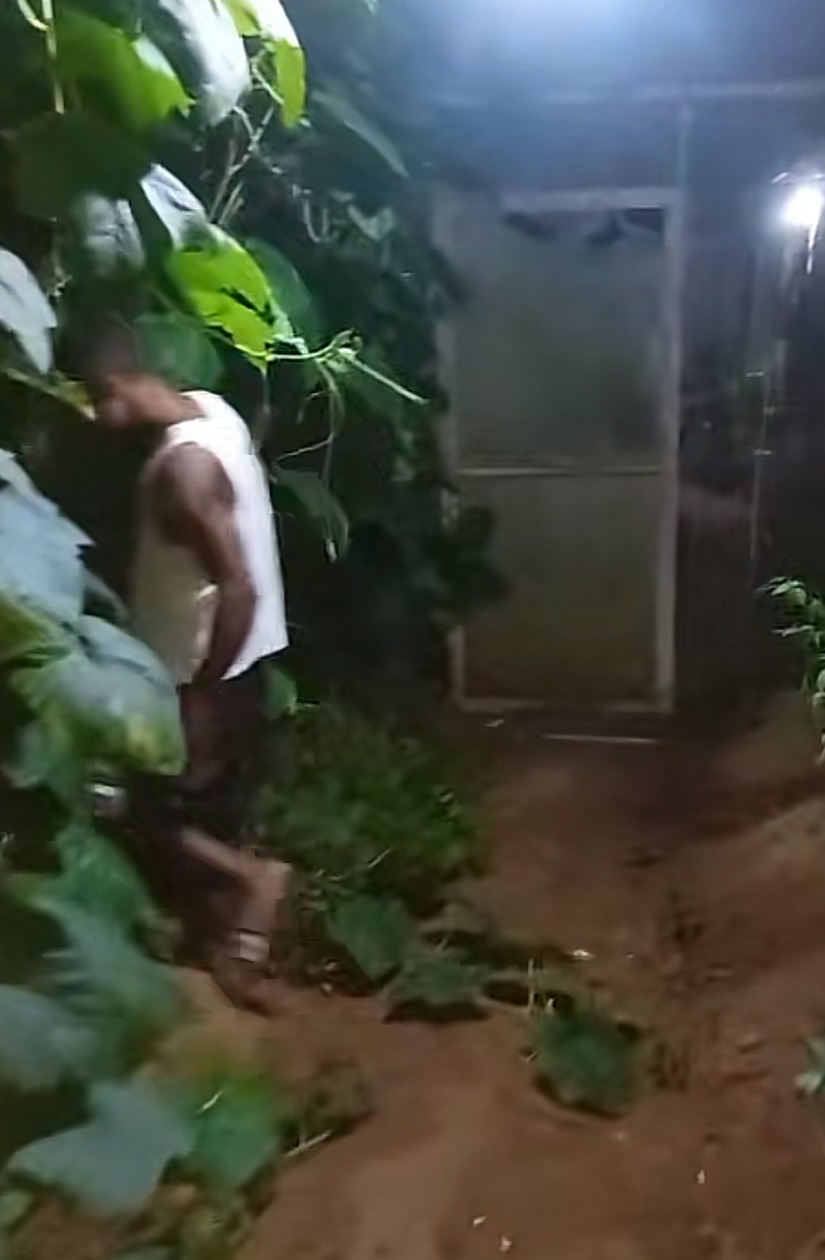
4. Looking after dark does not mean watering after dark
Water storage gives a farmer choices about when to irrigate. It does not make every cooler hour an appropriate watering time.
Inside a greenhouse, falling temperatures can bring condensation on leaves and the covering. Extended canopy wetness can favour diseases such as Botrytis. UMass guidance on reducing greenhouse humidity emphasises keeping foliage dry overnight, avoiding unnecessary puddling and maintaining suitable air movement.
An evening round is therefore an opportunity to check for dripping, wet leaves and irrigation leaks—not an instruction to wet the canopy. Directing water to the root zone avoids deliberately wetting leaves, but irrigation still needs to follow actual crop and growing-medium needs.
The greenhouse guidance cited here includes temperate-climate systems. Its general moisture-management principles are useful, but a Nigerian grower should not copy a heating or ventilation prescription without considering local conditions.
For our proposed observation record, I would add two plain questions: is the foliage wet, and is there standing water where we would not expect it? A photograph and a named location make those questions easier to investigate the next morning.
Stored water gives us flexibility. Observation should help us decide how to use it.
5. Turn the evening walk into knowledge the farm can keep
A light makes an inspection possible. A record makes it possible for somebody else to understand what happened.
This is not just paperwork. Oklahoma State’s scouting guidance treats records and mapped locations as central to tracking problems and assessing interventions. Monitoring can also help avoid unnecessary routine pesticide applications, although it does not remove the need for appropriate control when a problem warrants it.
For Excell Africa Farms, I propose a simple format that can fit into a notebook or a WhatsApp message:
Date and time → bed or plant location → observation → photograph → action or question → person responsible for follow-up.
Here is an illustrative entry, not an observation recorded from the photographs:
“Evening greenhouse round. Bed 2, entrance end: damage noticed on two leaves. Cause not identified. Leaf undersides photographed. Location marked for a daylight check. No treatment applied. Follow-up assigned to the morning team.”
The useful feature of that note is its restraint. It distinguishes what was seen from what remains unknown. It also gives the next person a place to start.
A second note might record that a previously reported problem was checked and had not changed. Another might describe a loose support that needs attention. The aim is not to manufacture a dramatic discovery every evening. It is to leave an accurate account.
This also provides a practical learning exercise. Ask an agricultural learner to explain what they inspected, what evidence they collected, what they could not establish and what would justify the next action. The assessment is not whether they can produce the longest report. It is whether their reasoning is clear enough for another person to follow.
That is what we mean when we argue that the farm can become a classroom. A greenhouse round can become an observation, a question, a documented investigation and eventually a lesson worth sharing.
For a small farm, I would keep the process proportionate: allocate a realistic inspection window, share the responsibility and review whether the information is useful. This is not a proposal for a farmer to work twenty-four hours a day.
The goal is a farm that can be observed and managed at the right time—not a farmer who never gets to rest.
We have not demonstrated a yield increase, diagnosed a disease or calculated a return on investment from these photographs. We have shown something more modest, but worth building on: solar-powered lights make a night-time inspection possible.
What we do with that opportunity is the real story.
From Soil to Significance
At Excell Africa Farms, we grow, observe, question and document. Our aim is to turn practical experience into knowledge that other farmers and learners can examine—not promises they must accept on trust.
Start your own observation record: choose one clearly identified part of the farm, write down what you actually see and set a follow-up. To share a farm-learning question with Just Learn, use our contact form. Continue exploring our work in Enterprise & Agriculture and the Just Learn library.
Evidence and image credits
The technical sources are linked beside the relevant claims: UC Integrated Pest Management, Oklahoma State University Extension, the US Department of Energy and two UMass Extension resources. They support the general principles discussed; they are not reports of trials at Excell Africa Farms.
Image source: screenshots supplied by Anthony Omokhodion from a TikTok video displaying the account name TOHEEB_FARMBOY. The article images are direct crops to remove the on-screen interface, with no AI-generated replacement or invented detail. The original night-time video frames have limited detail and are not a basis for diagnosing crop problems.