My sister Ene sent a photograph to our family WhatsApp group. She had bumped into Tony Elumelu on the streets of New York.
Somewhere in the exchange that followed, I described him as an “Ekpoma boy.”
Ene replied that he had been quick to explain that he was an Asaba boy, although he had attended BENSU.
A chance encounter in New York had brought the conversation straight back home.
It was a lovely moment to share. But beyond the familiar name and the photograph, something else caught my attention: the question of what people are building, and the work that takes place long before anybody thinks to take their picture.
How does an enterprise become more than the daily effort of the person who started it?
That question is not only about Tony Elumelu. Ene has her own business story. In her public posts, she describes leaving a 30-year corporate career and starting a business at 55. Her work now centres on speaking, events and retreats, with a particular interest in helping people give their experience a new purpose.
Starting again does not erase what came before. Neither does a long career remove the need to learn how to find customers, shape an offer and run a new enterprise. Experience is something to work with—not a guarantee that the next chapter will write itself.
That brings me back to my own work: the farm in Wasinmi, the books, the teaching and the wider organisation we are trying to build.
There is no shortage of ideas. The harder task is deciding which ones deserve our resources, delivering something people value and putting arrangements in place so that progress does not depend on one person remembering everything.
A farm needs more than crops. A publishing business needs more than manuscripts. A training enterprise needs more than someone who knows the subject. Each needs a way to serve people reliably, account for its resources and pass knowledge from one person to another.
Those are the questions I want to explore—not because a brief encounter answers them, but because it prompted me to look again at our own work.
The photograph gave us a moment to enjoy. What are we building that can last beyond the moment?
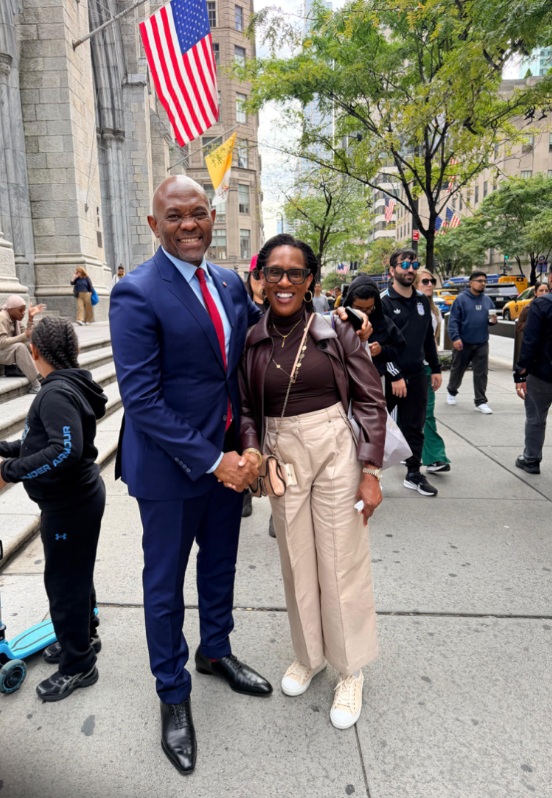
A New York Pavement—and a Conversation That Brought Us Home
Ene explained that Elumelu was in New York for the United Nations General Assembly. The UN’s programme for its eighty-first session places the 2026 general debate on 22–26 September and 28 September. That is the international backdrop to this very ordinary, very human exchange.
Yet our family conversation was not about the order of speeches. It was about home. “Asaba boy.” “Ekpoma boy.” A little clarification about where someone came from and where he studied.
For readers unfamiliar with the name, BENSU refers to Bendel State University in Ekpoma, now Ambrose Alli University. The university’s own history records those changes. The connection in our exchange was therefore to an actual place of learning, not an attempt to relocate anyone’s hometown.
What interests me is the relationship between those beginnings and the wider world. A photograph taken thousands of miles away can make familiar places feel unexpectedly close. It can also encourage us to ask whether we have been thinking too narrowly about what might emerge from the places we know.
That does not mean every local enterprise needs an overseas office. A business serving its immediate community well can be worth building. Nor does an international photograph establish anything about a person’s business performance. The useful question is what a wider ambition would require in practice.
For my own projects, it means asking whether a customer who has never met me can understand what is offered, place an order, receive the right product and know where to seek help. It means asking whether the work can be explained without my being present to explain every detail.
Those questions make the distance between Wasinmi and a customer elsewhere less abstract. We cannot simply declare that our work is ready for a wider audience. We have to make the buying, learning and delivery experience dependable enough for that audience.
That was the turn in my thinking. The encounter was a moment to enjoy. The next step was to bring the conversation home in another sense: to the decisions waiting on our own desks.
Beyond the Photograph: What Does It Take to Build a Business?
It is easy to study the visible parts of a business career: the title, the photograph, the conference appearance. I find it more useful to look for the work that came before them.
Elumelu’s official biography describes an early job selling copiers before a career in banking. It also recounts an application to Allstates Trust Bank that reached an interview despite his not meeting the stated qualification criteria. That is his published account, not something Ene learned in a detailed street-side interview.
I take two questions from it. What skills were developed through the earlier work? And who made an opportunity available? Neither determination alone nor luck alone is a complete explanation of a business career.
Another practical reference is the Tony Elumelu Foundation’s published 2026 programme. Its offer combines US$5,000 in seed capital with business training and mentorship. I am referring to the structure of that programme, not claiming that applications are currently open or that participation guarantees commercial success.
The combination is worth thinking about. A founder needs resources, but also decisions about how those resources will be used. What is being sold? To whom? How will the business know whether an order left enough money to pay for the work and replenish what was used?
On a farm, those questions become feed purchases, crop losses, staff time, transport and the next production cycle. In publishing, they become editing, design, payment processing, product delivery and reader support. The transactions differ; the need to account for them remains.
My test is deliberately unglamorous. Can we explain the offer in a few sentences? Do we know what delivery involves? Is there a record of what was sold and what it cost? Can someone distinguish a paid order from an enquiry without asking the founder?
There is also a question about restraint. Another product is not necessarily the next useful step. Sometimes the better decision is to make the existing product easier to buy, correct an unreliable delivery process or stop an activity whose costs we do not understand.
Admiration becomes useful when it changes a decision. I do not need to copy someone else’s career to improve our own record keeping, customer communication or allocation of responsibilities. Those are decisions available to us now.
The Other Entrepreneur in the Story: Ene’s Own New Beginning
Ene should not disappear from this article once the familiar name has attracted attention. She has a professional story of her own, and she has been describing it publicly.
Her account of leaving a 30-year corporate career and starting a business at 55 challenges a particular way of talking about a new beginning. “Starting again” can sound as though everything learned before that point has become irrelevant. I do not see it that way.
Her public profile describes helping people turn decades of experience and expertise into a signature talk and their own stage, alongside boutique events and retreats. That is more specific than the instruction to “follow your passion”. It identifies material people may already possess and a form in which they could make it useful.
There is a distinction here between having experience and organising it for somebody else. A person might know a great deal about leading teams, handling difficult transitions or teaching a practical skill. A paying audience still needs a clear answer to another question: what will this talk, session or programme help me understand or do?
For example, a teacher’s collection of lesson notes is not automatically a course. It needs a learner, a sequence, explanations and a way to practise. A farmer’s collection of observations is not automatically a manual. It needs context, evidence and an honest account of what remains uncertain. These are examples of the work of shaping knowledge, not claims about Ene’s particular clients.
Her posts also describe imagining an event in New York for women reinventing their lives. An ambition is not the same as a completed event, and I would not present it as one. But it reveals the question she is exploring: what might the next stage of her work look like?
I find that question more useful than arguing about whether a particular age is “too late”. The practical considerations remain the audience, the offer, available resources, responsibilities and willingness to learn what the new business requires.
No one needs to abandon a job to make this reflection worthwhile. Someone can begin by examining a skill, testing a small offer within their circumstances or organising knowledge they already use. A later beginning deserves neither dismissal nor a promise of easy success.
Starting a new business does not mean starting without experience. It means deciding what to carry forward—and what to learn afresh.
That is why Ene belongs at the centre of the story, rather than merely beside someone else’s achievements.
Bringing the Question Back to Wasinmi: What Are We Building?
At Excell Africa Farms, these questions become wonderfully concrete. A bird is missing. A crop behaves unexpectedly. A photograph reveals something we had overlooked. The decision is whether the incident remains a passing conversation or becomes a useful part of how we work.
One recent example was the hidden clutch of 15 eggs we wrote about on JustLearn. The discovery began with a question about the eggs, but it also raised an operational question: how had that production accumulated without being recorded?

The point is not to announce that one article has solved farm management. It is to use a specific incident to improve a specific routine, then check whether that routine is followed. A headcount, an egg record and a clear response when something is missing are more useful than a general instruction to “be careful”.
This is also where the farm, the writing and the teaching can support one another. The observation supplies a real question. Research helps distinguish what we know from what we are guessing. An article explains the issue. A book can place it alongside related lessons. Teaching can give a learner practice in applying the principle.
That sequence does not turn every photograph into a product. Some observations are too incomplete. Some lessons belong in a short free article. A book has to offer more than a bundle of material that has been placed behind a payment button.
In Built in a Week. Backed by a Lifetime, we explored this distinction in the development of JustLearn. The website gives existing work a clearer home; it does not create the underlying experience.
Our intended division of work is straightforward: JustLearn explains through articles and books; Sharper Minds develops teaching; separately agreed implementation work belongs with ILBSUK. These are different needs, not a requirement for a reader to purchase everything. Someone buying a book should be able to receive the book without entering a consultation process.
The larger ambition is the Omokhodion Organisation. But an organisation becomes useful through arrangements that actually work, not through the number of names placed under its umbrella.
For me, progress means a reader finding the right article, a buyer receiving the correct edition, a member of staff knowing what to record and a lesson being improved when the evidence changes. Those are small outcomes individually. Together they describe the business we are trying to build.
The farm is not only a place where we produce. It is also a place where we can learn how to organise production—and teach what the experience genuinely supports.
From a Founder’s Effort to a Business That Can Endure
The question I keep returning to is what happens when the founder is unavailable. Not permanently—just for an ordinary day in which something else needs attention.
Can another person find the order record? Do they know which version of the product is current? Can they see what was promised to the customer? Do they know which decisions they can make and which need approval?
A business does not become stronger simply by generating more activity. It becomes less dependent on memory when important information is recorded, easy to find and connected to a clear responsibility.
There is no need to begin with a complicated manual. I would start with one recurring task: receiving an order, checking livestock, delivering a digital book or preparing a teaching session. Write down the trigger, the steps, the person responsible, the evidence of completion and what to do when something goes wrong.
Then let another person use that record. Where do they hesitate? Which instruction assumes knowledge that has never been written down? What has changed since the procedure was created? The value lies in that test, not in the document’s length.
Records also need review. A sales list does little good when nobody checks outstanding orders. A farm log is less useful when discrepancies remain unexplained. The next question after “Did we record it?” should be “What decision does the record require?”
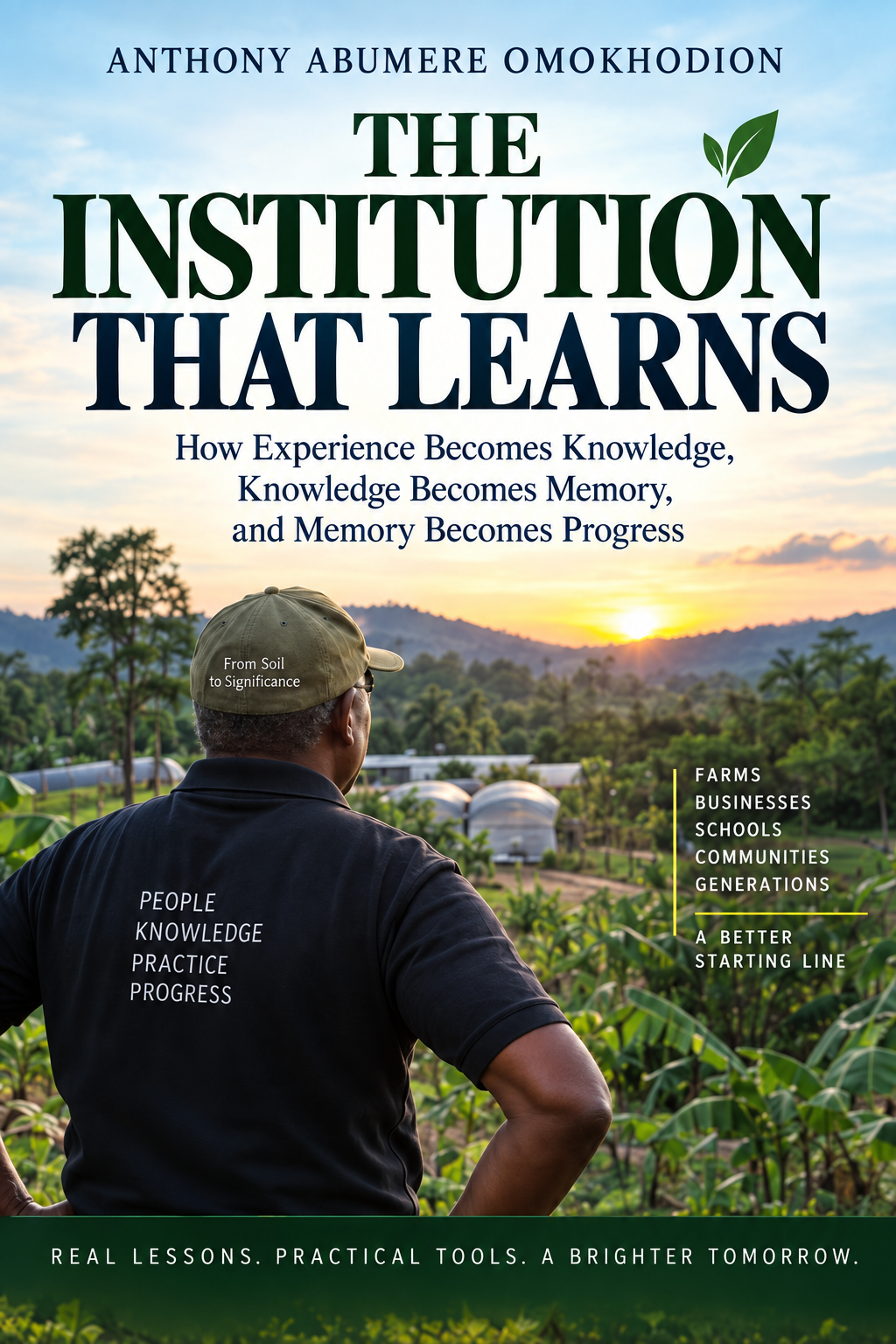
That is the concern behind The Institution That Learns: how experience can remain useful beyond the person and the moment that produced it. I do not mean preserving every old practice. A record should make correction possible, not turn yesterday’s mistake into tomorrow’s rule.
For a reader wondering where to begin, I would choose three actions for the coming week. First, describe one offer clearly enough that a stranger can understand it. Second, make one recurring task repeatable by someone else. Third, take one recent mistake or surprise and change a routine in response.
None of these actions guarantees that a business will last. Customers, resources and circumstances still matter. But they give the founder something more concrete to work on than another declaration of ambition.
Ene’s photograph remains a lovely family moment. Her own professional reinvention gives it another dimension. The Asaba–Ekpoma exchange gives it warmth. The New York setting gives it an international backdrop.
What I take home from it, however, is a responsibility rather than a borrowed status. We have our own customers to serve, our own work to improve and our own people to equip.
When the excitement of the encounter has passed, what will we do differently in the businesses we are building?
That is where I want the photograph to lead: back to the work, with a clearer idea of what the next useful step should be.
Continue the conversation
Explore the JustLearn book library, including The Farm Is the University, The One-Man Farm, The Arbitrage Farmer and The Institution That Learns. Or continue with our free articles on enterprise, agriculture and learning.
For a question about the work or a relevant implementation enquiry, use the JustLearn contact form. Buying a book does not require booking a consultation.
Sources and editorial note
The encounter and the brief Asaba–Ekpoma exchange are drawn from Ene Obi’s account, shared with Anthony Omokhodion. Her career transition and speaking, events and retreats work are described in the public Instagram posts and profile supplied for this article. Background sources are the United Nations’ 2026 programme, Ambrose Alli University’s history, Elumelu’s official biography and the Foundation’s January 2026 programme announcement.
This is Anthony Omokhodion’s personal reflection, not an interview with Tony Elumelu. The encounter does not imply endorsement, sponsorship or a business relationship between Elumelu or his Foundation and the author’s enterprises. Programme details are background information, not a current application invitation.