At Excell Africa Farms in Mondouku, Côte d’Ivoire, a mixed-age
Muscovy flock offers practical lessons in breed identification,
husbandry, biosecurity and building a responsible farm
enterprise.
At the water’s edge at Excell Africa Farms in Mondouku, Côte
d’Ivoire, a mixed-age flock of ducks moves between the shaded bank and
the pond. Some are already fully grown, with black-and-white plumage and
the distinctive red facial caruncles of adult Muscovy ducks. Around
them, younger birds at different stages of feather development reveal
something equally important: this is not merely a collection of birds—it
is a living breeding flock.
These are Muscovy ducks, not Pekin ducks. That distinction matters.
Although both may be raised for meat and eggs, they differ in
appearance, behaviour, breeding and management. Correctly identifying
the bird is the first step towards understanding what it needs and what
it may contribute to an African farming system.
Our Mondouku flock offers an opportunity to learn from real
conditions. The ducks have access to water, natural shade and space to
forage. Adults and young birds live beside the pond, allowing us to
observe how Muscovy ducks behave, reproduce and adapt within a working
tropical farm.
This article examines what Muscovy ducks are, why farmers may
consider them, what responsible management requires and what we are
learning at Excell Africa Farms. It is not a promise of effortless
profit. It is a practical account of an often-overlooked bird—and an
exploration of whether a well-managed Muscovy flock can become a useful
part of a diversified African farm.
1. Meet the Muscovy duck
The Muscovy duck’s scientific name is Cairina moschata. It
is a distinct duck species rather than a colour variety of the familiar
mallard-derived domestic duck. Pekin ducks belong to that
mallard-derived group; Muscovies do not. The difference is biological as
well as visual.
Adult Muscovies are most easily recognised by the bare, red, textured
skin around the face and bill. These fleshy areas are called caruncles.
They become more obvious as the bird matures and are usually more
prominent in males. The Cornell Lab of Ornithology also notes the
species’ long-necked appearance, variable domestic plumage and strong
claws. Domestic birds can be white, black, brown, blue-grey or mixtures
of these colours, so colour alone is not a reliable identification
test.
The Mondouku photographs show these identifying features clearly.
Several adults have red facial caruncles, broad bodies and
black-and-white plumage. Younger birds lack the fully developed facial
markings, but their body shape and their association with the adults
support the identification. Differences in size among mature birds may
help distinguish drakes from females, although photographs alone cannot
confirm the sex of every individual.
Muscovies also behave differently from many conventional domestic
ducks. They spend substantial time on land, can perch and may fly more
effectively than heavy Pekin-type birds. Their name can therefore create
a misleading picture: they benefit from water, but they do not have to
spend all day swimming. A farm needs to manage both parts of their
environment—the wet area and the dry area.
Reproduction is another important distinction. A government
duck-raising guide from the Philippines gives a Muscovy incubation
period of about 33 to 35 days, longer than the roughly 28 days commonly
associated with mallard-derived domestic ducks. FAO field material also
describes Muscovy hens as capable natural sitters, sometimes covering 10
to 15 eggs. That broodiness can be useful on a small farm, but it does
not remove the need to record dates, protect nests and monitor ducklings
after hatch.
Muscovy or Pekin? A
quick field comparison
| Feature | Muscovy duck | Pekin-type duck |
|---|---|---|
| Face | Red caruncles develop around the eyes and bill | Smooth, feathered face |
| Typical domestic plumage | Highly variable; white, black and mixed patterns are common | Usually white |
| Land behaviour | Strong land and perching tendency | Generally more ground-bound |
| Flight ability | Some birds can fly well | Heavy birds are usually poor fliers |
| Natural incubation | About 33–35 days | Commonly about 28 days |
The comparison is not a ranking. It is a reminder that a management
plan written for Pekins should not simply be copied across to
Muscovies.
2. Why Muscovy
ducks suit many African farms
Muscovies can make sense in African smallholder and mixed-farm
settings because their behaviour fits a system that combines shelter,
managed feeding and outdoor foraging. FAO’s small-scale poultry guidance
recognises that family poultry can use locally available resources while
contributing food, income and farm resilience. The opportunity is not
that the birds cost nothing to keep; it is that good management can
combine purchased inputs with the productive use of space, vegetation
and farm by-products.
They are active foragers
Muscovies search the ground for plant material, seeds, insects and
other small food items. This activity can complement a balanced ration
and may help the birds make productive use of orchards or other suitable
farm areas. It must not be confused with a complete feeding programme.
What birds find outdoors varies with the season, weather, stocking level
and the condition of the land. Growing ducklings, laying females and
breeding birds still require appropriate nutrition.
They can reproduce naturally
A broody Muscovy hen can incubate her own eggs and rear ducklings.
For a farm building breeding stock gradually, that may reduce dependence
on an incubator. Natural hatching, however, has its own management
demands: protected nest sites, daily records, separation from
disturbance and a safe brooding area once the ducklings emerge.
They fit diversified
production
A Muscovy enterprise does not have to depend on a single product.
Depending on local demand and regulation, the flock may support meat
production, hatching eggs, breeding trios or young stock. Manure can
also enter a properly managed soil-fertility system. Each possible
output needs its own market test and cost record; none should be assumed
profitable simply because the birds are present.
They are well
suited to observational learning
A mixed-age flock makes the production cycle visible. Farmers and
learners can observe courtship, nesting, hatching, juvenile growth,
foraging and social behaviour in one place. That makes the flock
valuable not only as livestock but also as a practical teaching
resource—provided animal welfare comes before demonstration.
There are trade-offs. Muscovies that can fly may leave an insecure
range or roost in difficult places. Broody hens temporarily stop laying.
Outdoor access increases contact with mud, parasites, wildlife and
contaminated water. A hardy reputation should never become an excuse for
weak housing, irregular feeding or delayed veterinary care.
3. Inside our Mondouku flock
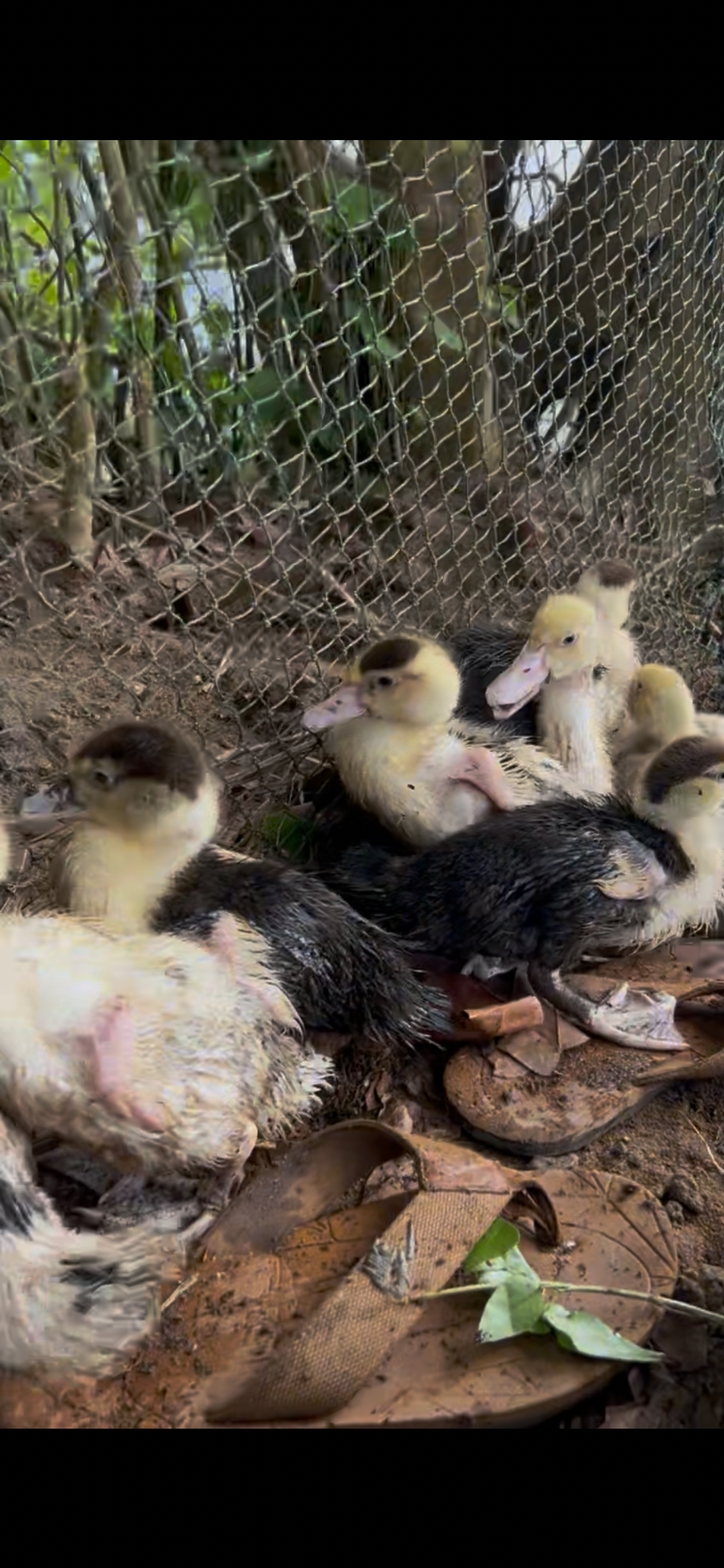
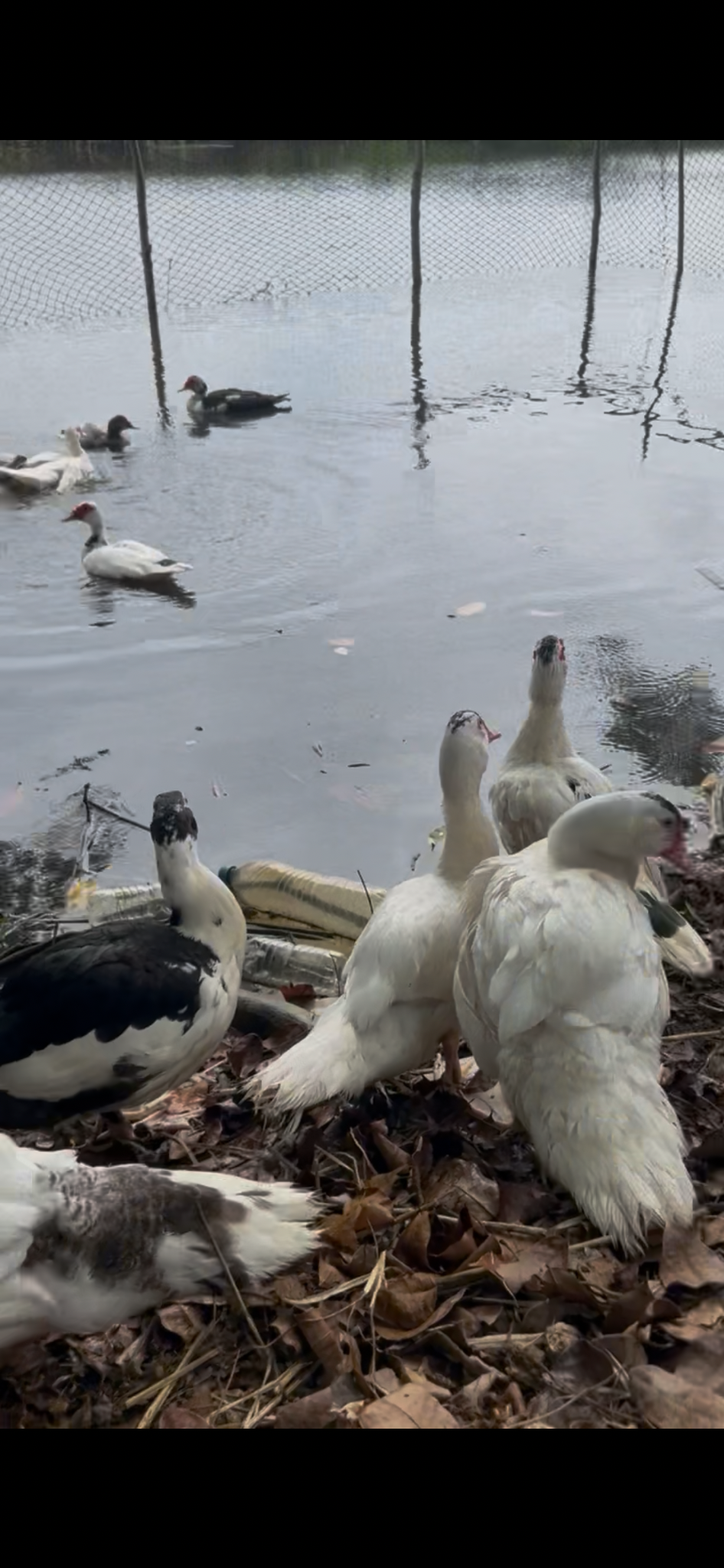
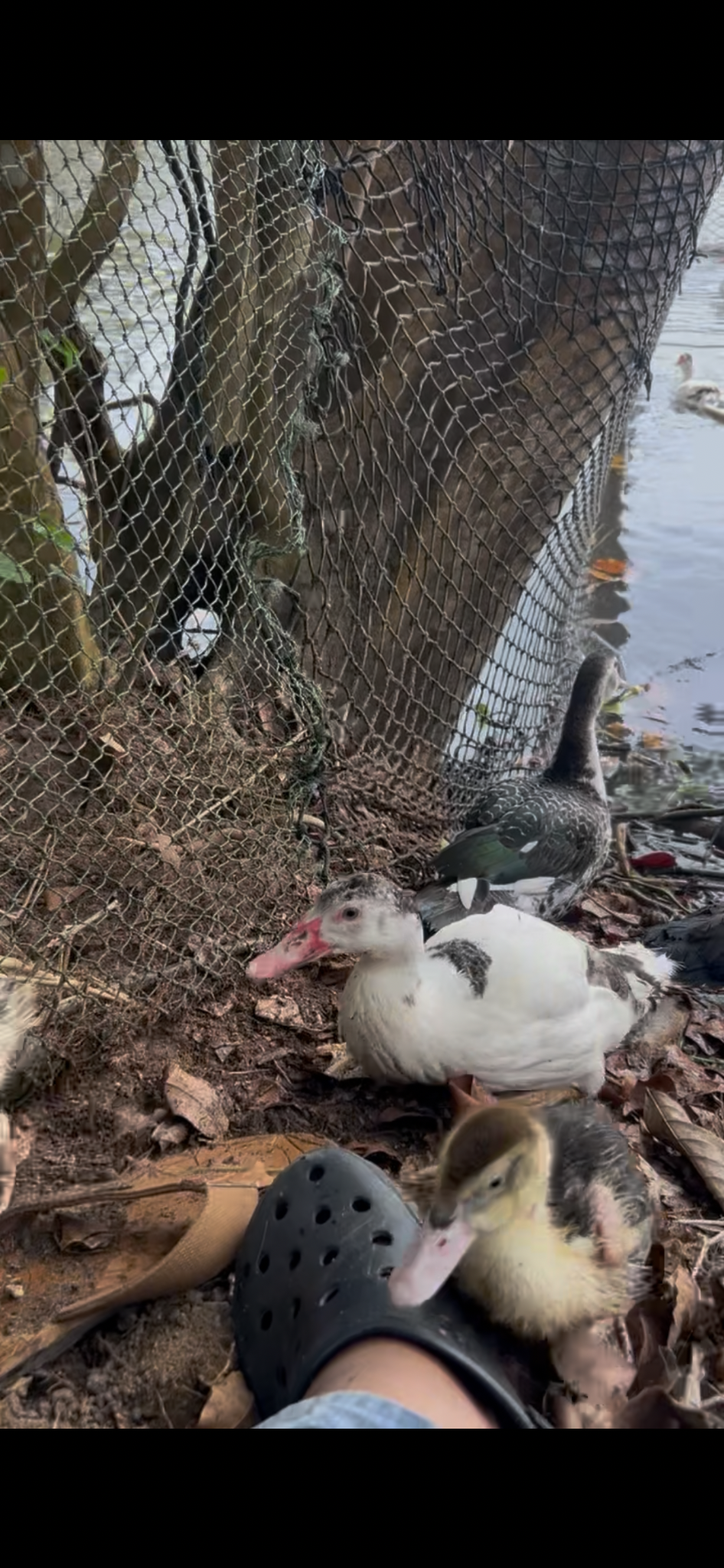
The photographs supplied by Excell Africa Farms document adults,
growing juveniles and younger ducklings beside a fenced pond. We can see
natural shade from mature trees, water access, a soft bank for resting
and enough room for some birds to move between land and water. We can
also see the closeness between age groups: adults and young stock occupy
the same general environment.
That mix tells us the flock is reproducing, but the images do not by
themselves prove fertility rate, hatchability, growth performance or
commercial success. Those are measured outcomes. A responsible farm
story separates what can be observed from what still needs to be
recorded.
What the photographs support
- The flock is predominantly Muscovy, with the adult facial caruncles
and body form visible in several frames. - More than one age group is present, including ducklings and
substantially feathered juveniles. - The birds use both the pond and the bank.
- The setting provides natural shade and opportunities for exploratory
behaviour. - Plumage varies across the flock, including white, black-and-white
and darker birds.
What the photographs
cannot establish
- The total flock size, because birds recur across multiple frames and
others may be out of view. - The sex ratio of every age group.
- The precise age or weight of the birds.
- Their health status, vaccination history or parasite burden.
- The farm’s feed conversion, mortality, hatchability or profit.
This boundary matters. Good agricultural learning begins with
accurate observation, then adds records, examination and expert advice.
It does not diagnose a flock from a photograph.
The images do, however, point towards useful management questions.
Some juveniles are in visibly uneven stages of feather development. That
may simply reflect normal growth, age differences, wet plumage or
moulting, but it is worth checking the birds closely for feather
pecking, skin irritation, external parasites and nutritional imbalance.
The pond edge also contains leaves and some visible discarded containers
or plastic. Removing sharp and non-biodegradable debris should be an
immediate housekeeping priority, both for bird safety and water
quality.
The netting provides a boundary, yet every enclosure should be walked
regularly to identify sagging sections, holes and entanglement points.
Muscovies have strong feet and claws, and both adults and growing birds
can investigate weaknesses. A secure perimeter protects the flock from
escape, dogs and other predators; it should also be designed so birds
cannot become trapped in loose mesh.
These are not criticisms of keeping ducks in a natural setting. They
are examples of what practical observation is for: recognising what
already works, then identifying the next improvement.
4. What Muscovy ducks need
to thrive
Access to a pond is an asset, but it is not a complete husbandry
system. The essentials are appropriate feed, safe water, dry shelter,
protection, biosecurity, health monitoring and reliable records.
Feed for the stage of growth
Use a complete feed formulated for ducks or waterfowl and matched to
the production stage—starter for young ducklings, grower for juveniles
and an appropriate breeder or layer ration when required. If a farm
mixes its own ration, formulation should be based on available
ingredients and professional nutrition advice rather than guesswork.
Foraging and suitable farm by-products may supplement the ration, but
the farm should not assume that scavenging provides consistent protein,
energy, vitamins and minerals. Feed should be kept dry, protected from
rodents and wild birds, and offered in a way that limits spillage into
mud or pond water. Sudden feed changes should be avoided.
Clean drinking
water as well as swimming water
Swimming water and drinking water serve different management
purposes. Birds should always have a clean, dependable drinking supply.
Containers must be stable and easy to clean, with an arrangement that
lets the duck immerse its bill while reducing the amount of water
spilled into bedding.
A natural pond can support exercise, bathing and normal behaviour,
but it also needs oversight. Run-off, stagnant areas, wild-bird access
and accumulated waste can increase health risks. Feeders should not be
placed where spilled feed washes directly into the pond. The bank should
drain well enough to avoid a permanently fouled bottleneck at the point
where every bird enters and leaves the water.
A dry, secure night shelter
Muscovies need a clean, ventilated, predator-resistant place to rest
at night and during severe weather. The floor or bedding should remain
as dry as practical. Damp litter encourages odour, pests and disease
pressure. Nest boxes should be in a protected area where eggs can be
found, recorded and collected without excessive disturbance.
Young ducklings require closer control of warmth, dryness and access
to water. They should not be left to become chilled after getting wet,
and their drinking equipment must not create a drowning hazard. Mixing
very small ducklings with large adults also deserves careful
supervision: competition at feeders and accidental trampling can be
missed in a visually busy flock.
Planned biosecurity
The World Organisation for Animal Health recommends a written
biosecurity plan, flock-level health and production records, control of
visitors and equipment, protection of feed from wild birds and rodents,
dry litter and safe removal of dead birds. For an outdoor Muscovy flock,
those principles can be adapted into a simple routine:
- Quarantine new birds before they join the resident flock.
- Use dedicated or cleaned footwear and equipment in the duck
area. - Keep feed stores closed and clear spilled feed promptly.
- Separate age or production groups where practical, especially the
youngest birds. - Inspect the flock every day for appetite, movement, breathing,
droppings, wounds and abnormal deaths. - Record treatments and use medicines only under appropriate
veterinary direction. - Consult a veterinarian promptly when several birds become ill,
deaths occur suddenly or an unusual sign spreads.
Waterfowl farms should also pay attention to contact with wild birds.
Outdoor access can be valuable, but it is not biosecurity-neutral. Local
veterinary authorities should guide vaccination, testing and disease
reporting because requirements vary by country and current disease
conditions.
Welfare through routine
observation
The quickest flock check is often behavioural. Are the birds alert?
Are they eating and drinking? Do they walk evenly? Are they preening?
Are smaller birds reaching feed, or are dominant adults blocking them?
Is any individual sitting apart, breathing with effort or showing a
wound?
Observation should be followed by action. A sick or injured bird may
need to be isolated for examination, but isolation must still provide
water, appropriate feed, shade and protection. Routine weighing of a
sample of birds can reveal growth problems before appearance alone
does.
5. From farm flock
to sustainable enterprise
The central enterprise question is not, “Can Muscovy ducks survive
here?” The photographs already show a breeding flock living in Mondouku.
The better question is, “Can the farm convert good husbandry into a
consistent, measurable product that local customers value?”
That requires a trial with records.
Start with a defined
production objective
A single flock should not be expected to optimise meat, egg sales,
breeding stock and teaching activity all at once. Excell Africa Farms
can begin by naming a primary objective for the next production cycle.
For example:
- produce healthy growers for a tested local meat market;
- improve the number and quality of breeding birds;
- measure natural hatchability under protected nesting conditions;
or - develop a small demonstration unit for practical farm learning.
The objective determines which birds to keep, what to measure and
where money should be spent.
Measure the biological
results
At minimum, maintain a flock register with adult breeding numbers,
eggs set, eggs hatched, ducklings alive at key ages, deaths, treatments
and birds sold. Dates matter. Without them, a flock can appear active
while quietly losing money through poor hatchability, slow growth or
preventable juvenile losses.
For breeding, the most useful measures include fertility,
hatchability of fertile eggs, duckling survival and the performance of
each breeding group. For meat production, track starting numbers,
weights, feed used, mortality, age at sale and sale weight. Records need
not begin with complicated software; a disciplined paper sheet or
spreadsheet is enough if it is updated consistently.
Calculate the real cost
Foraging may reduce some feed demand, but feed is only one expense. A
serious cost record includes purchased feed, labour, shelter, fencing,
water systems, veterinary care, transport, losses and the value of
breeding stock. It should also account for the time spent collecting
eggs, cleaning, supervising young birds and finding buyers.
Income should be recorded by product and customer type. A premium
price for breeding stock is not the same market as routine meat sales,
and neither should be projected without evidence of buyers.
Build the market
before scaling the flock
Muscovy meat is not equally familiar in every community. The farm
should speak with households, restaurants, traders and other farmers
before increasing breeding numbers. Questions should cover preferred
bird size, live versus processed sales, seasonal demand, price,
frequency and any cultural preferences.
Food safety and slaughter requirements must be checked locally before
processed birds or eggs are sold. A production plan without a lawful,
hygienic route to market is incomplete.
Improve in small cycles
The Mondouku flock can become a strong pilot unit if each cycle has a
question. Does separating younger birds improve survival? Does a
protected nesting area raise hatchability? Does better drainage at the
pond entrance improve cleanliness? Does weighing birds every two weeks
identify a feeding problem early?
Each question creates a simple test. Each test creates evidence. That
is how a farm develops a repeatable system instead of relying on
impressions.
The lesson from Mondouku
Muscovy ducks are easy to recognise once we know what to look for,
but successful Muscovy farming is not defined by the red caruncles
alone. It depends on the less dramatic disciplines: clean water,
appropriate feeding, secure dry shelter, protected young stock, daily
observation, biosecurity and records that connect biological performance
to cost and market demand.
The Excell Africa Farms photographs show a promising foundation—a
breeding flock, multiple generations, natural shade and access to water.
They also show why field learning matters. The same image that captures
attractive birds beside a pond can prompt practical questions about
debris, fencing, age-group management and health checks.
That is the purpose of JustLearn: to turn real situations into useful
knowledge. The next stage for the Mondouku flock is not to make grand
claims. It is to measure, improve and share what the farm learns. If
that work is done consistently, the flock can contribute not only ducks
but evidence—a locally grounded example of how responsible livestock
management becomes a sustainable enterprise.
Turn observation into practical learning
JustLearn documents what Excell Africa Farms is learning from the Mondouku flock. Sharper Minds Academy turns those observations into structured learning for farmers and agricultural entrepreneurs.
This article is for general education. Farm-specific health,
medication, vaccination and disease-control decisions should be made
with a qualified veterinarian and the relevant local
authorities.