For generations, when we pictured a farm, we pictured soil, crops, livestock and perhaps a tractor.
That picture is becoming incomplete.
Look at the modern farm differently.
There is still soil. There are still seeds. There are still farmers. But alongside them may now sit a solar inverter, battery storage, a Starlink connection, computers, cameras, sensors, microphones—and artificial intelligence.
At Excell Africa Farms, this is the direction in which we are travelling.
Not technology instead of farming. Technology in the service of farming.
From Urban Technology to Rural Production
One of the great opportunities for African agriculture may be the removal of an artificial boundary we have created between the “technology economy” and the “rural economy.”
Why should sophisticated technology belong principally to Lagos, London, Johannesburg, Nairobi or Silicon Valley?
Why can’t it sit beside a pineapple field in Wasinmi?
Imagine a farm where solar power keeps the operation running, Starlink connects it to the world, cameras provide security and remote observation, digital systems record production, and AI helps analyse information and solve problems.
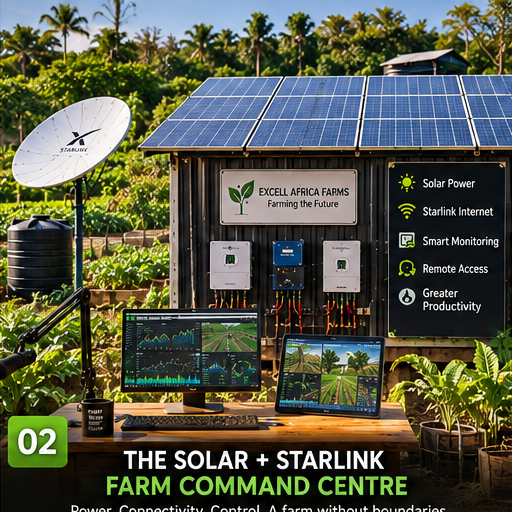
The Solar + Starlink Farm Command Centre
This is why infrastructure such as renewable energy and satellite internet matters.
Electricity allows equipment to operate. Connectivity allows a rural farm to participate in the global knowledge economy.
A farmer sitting amongst crops can speak with an agronomist thousands of miles away, research a disease, attend a course, analyse a photograph with AI, teach a class, publish an article or broadcast a podcast.
The physical location remains rural. The intellectual reach becomes global.
And Then AI Arrives on the Farm
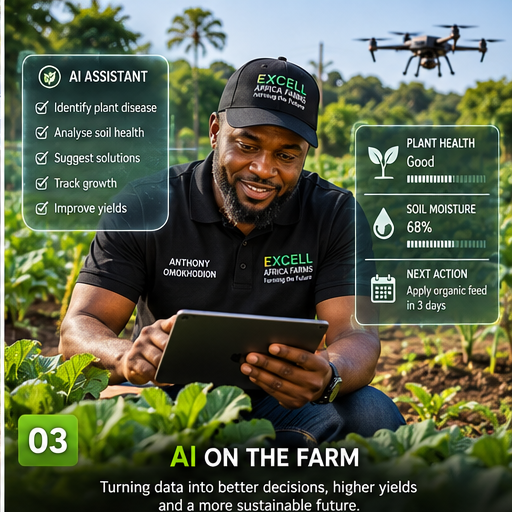
Artificial intelligence makes this convergence even more interesting.
AI cannot plant our crops for us simply because we typed a clever prompt. Someone still has to farm.
But AI can help us think about what we are seeing. It can help interrogate records, compare production methods, develop training material, analyse business models, document experiments and turn years of practical experience into knowledge that can be shared.
This is one reason I increasingly reject the idea that AI belongs primarily to office workers. Some of its most interesting applications may eventually be found far away from conventional offices: on farms, in workshops, in schools, inside small African businesses and in communities previously separated from sophisticated knowledge infrastructure.
The Farm Becomes a Classroom
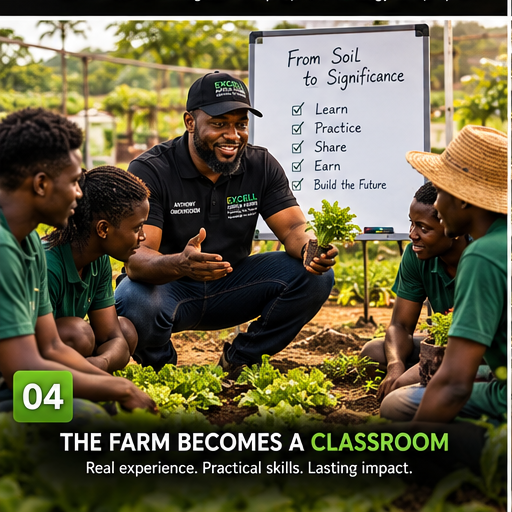
This is where the idea becomes particularly exciting.
A farmer encounters a problem this morning. Perhaps pepper prices have collapsed. Instead of simply accepting the loss, the farm experiments with dehydration and preservation.
The experience is documented. The economics are calculated. The mistakes are recorded. The lesson becomes an article. The article becomes a podcast. The podcast becomes training. The training helps another farmer avoid the same mistake.
Crop → experience → data → knowledge → content → education → enterprise.
That is a very different definition of agricultural productivity.
From Harvest to Higher Value
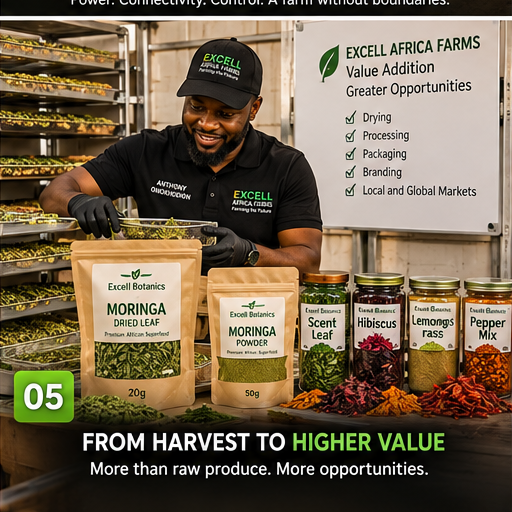
The same thinking applies after harvest. Growing the crop is only the beginning. Drying, processing, packaging, branding and reaching local or global markets can create additional value from the same productive land.
The modern farm therefore becomes more than a production site. It becomes a platform for experimentation, skills, value addition and enterprise.
The Farm Can Become a Media House Too
Put a camera and microphone into this environment and something else happens.
The farmer stops being merely the subject of somebody else’s documentary. The farmer becomes the broadcaster.
We can document what works. We can document what fails. We can interview practitioners. We can challenge agricultural assumptions. And we can allow people around the world to hear directly from the place where production is actually happening.
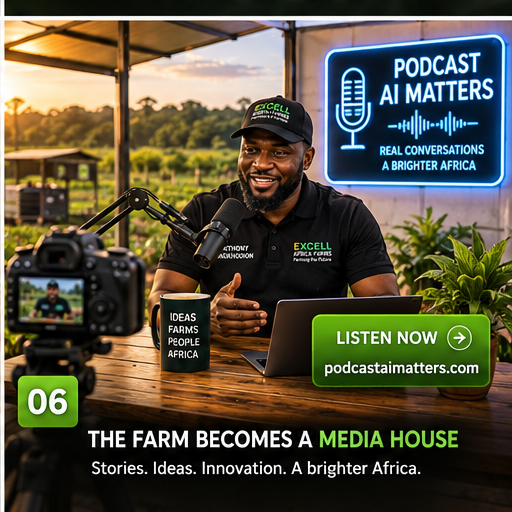
That is precisely where Podcast AI Matters fits into this experiment.
The microphone sitting beside the crops is symbolic. It says that knowledge no longer has to travel only from the city to the village. Knowledge can travel in the opposite direction too.
Wasinmi → London.
Farm → classroom.
Experience → AI.
Africa → world.
A modern farm is not just about planting seeds. It is about planting ideas, building systems and connecting knowledge with production.
At Excell Africa Farms, we are still farmers. We still plant. We still harvest. We still get things wrong.
But increasingly, the farm is also becoming a laboratory, classroom, studio and technology platform. And that may be one glimpse of what the African farm of the future looks like.
Continue the conversation
What happens when artificial intelligence leaves the office and meets the real world?
That is one of the conversations we are exploring on Podcast AI Matters—AI not simply as technology to talk about, but as a practical tool for agriculture, education, enterprise and everyday problem-solving.