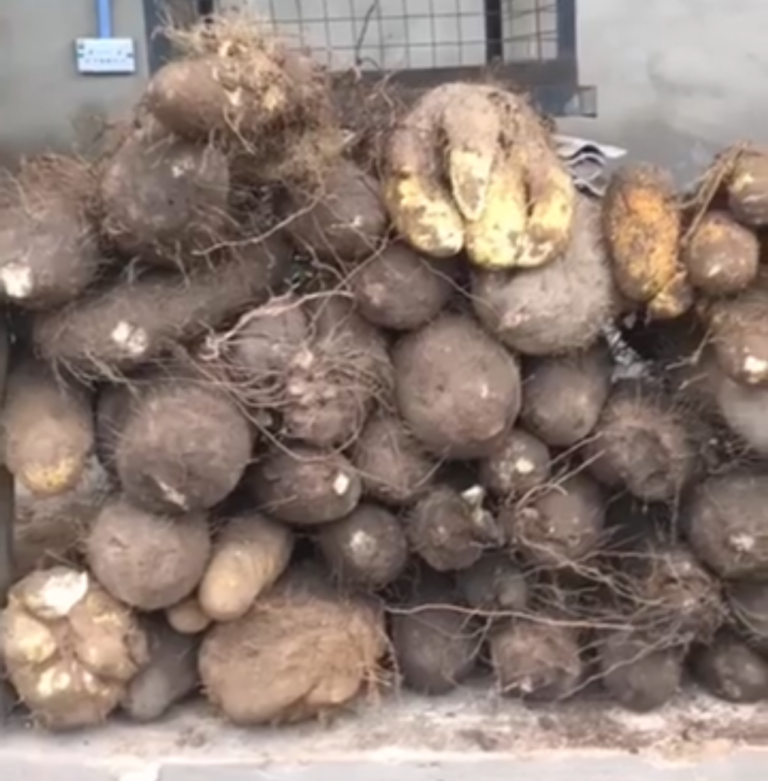
October 2023. A pile of yams. Victoria’s handiwork.
Looking at the old harvest footage again, I felt proud of what she had achieved. Then came the more uncomfortable thought: why are we still looking back at this result instead of building on it?
When I shared the video, my message was blunt. This harvest came from Victoria’s sack-farming efforts. Since then, we have not reproduced a comparable result. Yet some people still ridiculed her work.
That is where this story begins. Not with a claim that sacks are the answer to every yam farmer’s problems. Not with a competition between men and women. It begins with a person who produced something worth examining—and a farm that needs to ask what it learned.
Victoria deserves the credit. The rest of us need to consider the responsibility that comes with having seen her result.
1. Give Victoria her credit
It is easy to share a photograph of a harvest and write, ‘Look at what we produced.’ But that ‘we’ can hide the person whose work made the photograph possible.
In this case, I want to be specific. I associate this October 2023 yam harvest with Victoria and her sack-farming work. Recognising her contribution is not an optional courtesy added after the serious business of farming. It is part of telling the story accurately.
It also matters to what happens next. Once we acknowledge who did the work, we know whose experience we should try to understand. What decisions did she make? What did she notice? What would she repeat, and what would she change?
I do not want to invent those answers on her behalf. A photograph cannot supply her explanation. Nor should a polished article put words in her mouth.
The ridicule I referred to is my recollection of how some people responded to her work. I am not identifying those people here or claiming to know their motives. But there is a distinction worth making: questioning a method is legitimate; belittling the person is not the same as examining the method.
Ask about the costs. Ask how much work it required. Ask whether the result can be repeated. Those are useful questions. Dismissing the contribution does not answer any of them.
2. A photograph is evidence, not a farm account
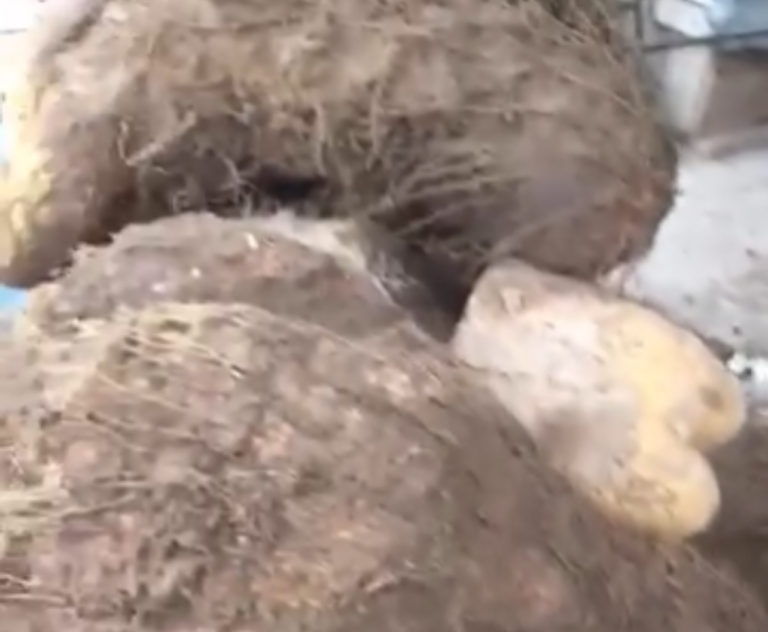
The footage shows a substantial pile of yam tubers, including some very large ones. It records a harvest worth taking seriously. It does not, by itself, establish how successful the enterprise was financially.
I cannot look at these pictures and honestly tell you the total harvest weight, the number of sacks planted, the weight of planting material, the hours of labour or the profit. Those figures are not established in the material I am sharing.
Nor can a harvest photograph prove that sack farming outperforms planting in the ground. We would need a fair comparison, with the relevant conditions and costs recorded, before making that claim.
That is not a reason to dismiss Victoria’s achievement. It is a reason to distinguish what we can see from what we still need to find out.
The pictures are a starting point for investigation, not permission to manufacture a success story around missing numbers.
The same care applies to my phrase, ‘Since then, nada.’ I am talking about our failure to reproduce a comparable sack-grown yam result. I am not saying that the entire farm has produced nothing since 2023.
And I should not treat the absence of a comparable harvest as proof that the method failed. Was it repeated under comparable conditions and unsuccessful? Was it attempted differently? Was it simply not continued? Those are separate possibilities. We need records before choosing an explanation.
3. Recognise the farmer, not just the harvest
In my message, I asked whether farms are now ‘ruled by women’. There was frustration behind that question: here was a woman whose work I was pointing to, while remembering that some people had still dismissed it.
But doing the work, producing results and having authority are three different things. My photographs cannot tell us who controls agriculture in Nigeria—or anywhere else.
A more useful question is whether we give capable women the recognition, responsibility and opportunity to explain their work that their contributions deserve.
There is a timely wider context. FAO’s official International Year of the Woman Farmer 2026 initiative highlights women’s roles in farming and food systems, alongside barriers involving land tenure, finance, technical support, services and education. That is a global context, not evidence about Victoria’s personal circumstances or a finding about our farm.
We do not need to turn her harvest into an argument that one sex is naturally better at farming. Nor do we need a global statistic before acknowledging a particular person’s contribution.
For me, the practical test is simpler. Would we listen equally carefully to the person explaining a result? Would we give credit by name? Would we offer the same opportunity to demonstrate and improve the method?
Accepting someone’s harvest while dismissing their knowledge is not a standard I want our farm to accept.
4. When Victoria knows, but the farm does not
This is the management question that stays with me: did we keep a memory of the harvest without retaining enough knowledge to repeat it?
For me, farm knowledge transfer means turning a person’s experience into something the farm can understand, test and retain—without erasing the person’s contribution.
I do not yet have a documented account that answers that question. But it is the right place to look. We need to know not only what Victoria did, but what the farm recorded, understood and passed on.
Was the planting material identified? Were planting and harvest dates recorded? Is there an account of the sacks, their contents and the work carried out during the growing period? Did another person observe the process closely enough to explain it afterwards?
Those questions should not become a retrospective demand that Victoria alone account for everything. Whoever manages an enterprise also has a responsibility to create time, support and a place for useful knowledge to be retained.
A contributor can explain a method, but the organisation must decide how that explanation becomes accessible to the next person who needs it.
This is what I mean by institutional memory. Not a grand computer system. Not a folder full of documents nobody reads. I mean knowledge that remains usable beyond the particular moment, conversation or individual in which it first appeared.
At Excell, a useful record could bring together dated photographs, the contributor’s explanation, observations from the work and the figures we actually measured. Where something is remembered rather than recorded, it should say so. Where something is unknown, the record should leave it unknown.
The photograph answers, ‘What did the harvest look like?’ It does not automatically answer, ‘What would another person need to understand to attempt this responsibly?’
Our earlier article, The 15 Eggs Nobody Knew Existed, raises a related concern about what a farm knows about its own activities. In this case, the question extends beyond knowing that something happened. It is whether we retained enough understanding to learn from it.
5. Make the next attempt a documented test
The response I would like to see is not a promise of another spectacular harvest. It is a fair attempt to recover the original account, identify what is missing and plan a repeat that produces usable evidence.
That would begin with the surviving records and, where possible, Victoria’s own explanation. We should separate what she remembers, what photographs or notes confirm, and what nobody can now establish.
Only then can we decide what a repeat should test. Repeating a method to understand its performance is one question. Comparing it with another growing method is a different question. A trial should be clear about which question it is trying to answer.
I would want the record to include the starting material, the number of planting units, dates, work carried out, losses, harvest weights and costs. It should account for the whole attempt, not just the best-looking tubers selected for a photograph.
I would also want another person involved in learning the process. The aim is not to make the original contributor less important. It is to make the contribution useful beyond a single successful season while preserving the credit for it.
If the result is disappointing, that should be recorded too. A documented disappointment can tell us something that a photograph of the best tuber cannot. If the result is promising, the next question is whether the quality, effort and economics justify continuing.
These are proposed next steps, not a claim that we have already completed a new trial or proved the method’s profitability.
There is also a question of fairness. We should not select an individual to blame for a result that depended on decisions, resources or arrangements outside their control. Equally, we should not use uncertainty as an excuse to stop asking why a promising piece of work was not carried forward.
Conclusion: the farm should grow its knowledge too
I can admire Victoria’s October 2023 harvest and still ask hard questions about what followed. In fact, taking her contribution seriously requires those questions.
What did we learn? What did we record? What did we give another person the opportunity to understand? What prevented a comparable result from being repeated?
I do not have to invent a villain, a profit figure or a scientific verdict to say that the work deserved attention. And recognising Victoria does not remove my own responsibility to examine how the farm learns.
Victoria grew the yams. Our responsibility is to make sure that more than the photograph survives.
Think of one good result in your own enterprise. Can you name the person behind it—and can someone else explain how it was achieved? That is a useful place to begin.
Read next: The 15 Eggs Nobody Knew Existed: Why Small Farms Need Inventory Control.
Source and image note: The October 2023 date, credit to Victoria and description of sack farming come from Anthony Omokhodion’s account and archive. His remarks about ridicule and the absence of a comparable follow-up harvest are personal recollections, not findings of a staff investigation. The supplied stills show the harvested tubers, not the growing process. No harvest weight, sack count, comparative yield or profit is independently established here. Original Facebook reel shared by the author. Wider context: FAO, International Year of the Woman Farmer 2026.