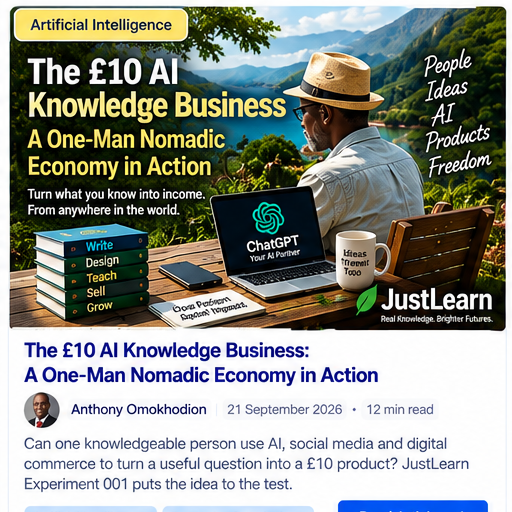
What if a viable knowledge business no longer needs an office, employees, stock, a classroom or even a fixed country — but one knowledgeable person, a phone or laptop, an internet connection and an AI assistant?
That question sounds theoretical until you watch a very ordinary commercial journey happen in front of you: somebody teaches something useful on social media, people respond with questions, and a small digital product sits one click away.
On 21 September 2026, one such example stopped us in our tracks. Instead of merely admiring it, we decided to turn the observation into an experiment.
The example that inspired JL-SMA Experiment 001: Cynthia Academy
The spark came from Cynthia Academy. Cynthia had published Facebook content explaining an issue many homeowners recognise: after years of monthly mortgage payments, why can the outstanding balance still appear stubbornly high?
The important thing for us was not simply the subject. It was what happened around the teaching. The post generated discussion. Readers asked about interest and principal, overpayments, equity, remortgaging, investing instead of overpaying, and when additional payments should begin.
In other words, the comments were doing more than creating engagement. They were revealing the curriculum.
And sitting at the end of that conversation was a simple offer: Cynthia’s $10 “Mortgage Guide: What They Didn’t Teach You in School” on Selar.
Credit where it is due. Cynthia Academy’s Facebook-to-Selar approach inspired this JustLearn experiment. We have no commercial relationship with Cynthia Academy and receive no commission if a reader buys her guide. We are, quite deliberately, unpaid promoters of the example that made us stop and think. Visit Cynthia Academy’s $10 Mortgage Guide on Selar →
We can see the public engagement and the $10 offer. We cannot see Cynthia’s sales data, so we make no claim about how many copies she sold or what she earned. That distinction is essential.
What we can study is the architecture:
USEFUL TEACHING → ATTENTION → CONVERSATION → QUESTIONS → FOCUSED PRODUCT → TRANSACTION → MORE QUESTIONS.
That is where our experiment begins.
Don’t start with the PDF
The easy lesson would be: “Make an ebook and sell it for $10.” That is not our lesson.
A PDF nobody wants is still a PDF nobody wants.
The more interesting sequence begins before the product exists. Teach something useful. Observe what people misunderstand. Listen to their objections. Notice which questions repeat. Then ask whether the unresolved part can become a practical resource worth paying for.
That reverses the usual approach of disappearing for three months to create a course and emerging afterwards in search of an audience.
The audience begins participating in product development before the product is built.
Then AI changes the economics
This is where ChatGPT and other AI tools enter the story — but with an important boundary.
AI should not manufacture expertise that the human does not possess. The human remains responsible for experience, judgement, accountability, specialist knowledge, source checking and the relationship with the audience.
AI’s value is leverage.
A knowledgeable person can use it to interrogate an idea, identify patterns across hundreds of comments, organise experience, challenge assumptions, research questions requiring verification, build an outline, draft and edit teaching material, create exercises, repurpose a long article into social posts, and analyse what happens after launch.
We explored this distinction in Don’t Just Ask AI Questions — Put AI to Work and Stop Typing. Start Talking: AI Has Changed How We Create.
The point is not that AI becomes the entrepreneur. The point is that one entrepreneur can command considerably more productive capability.
Enter the One-Man Nomadic Economy
Now the idea becomes larger than digital guides.
Imagine the minimum operating system of an enterprise:
- a person with useful knowledge or skill;
- a smartphone or laptop;
- internet connectivity;
- AI assistance;
- social or search distribution;
- a place to publish;
- a payment and delivery mechanism.
No conventional office is inherent in that list. Neither is a permanent geographical location.
We call this the One-Man Nomadic Economy. “One-man” describes minimum viable organisational scale, not gender. “Nomadic” does not require constant travel. It describes productive capability that, where the work permits, is increasingly detachable from a fixed workplace.
A person can think in London, record a lesson in Lagos, edit it in Abidjan, sell it to someone in Manchester and answer the next customer from Wasimi.
Knowledge travels. The enterprise can travel with it.
The farm and the digital enterprise are cousins
This sounds digital, but we have been developing the same argument from the soil upwards.
On the modern farm, mini-machines can allow one farmer to perform work that once required substantially more labour. Solar can decentralise energy. Sensors and AI can extend observation. Affordable freezing and preservation can give the farmer something enormously valuable: time.
That last point matters. Technology that means a farmer does not have to sell today can be as economically important as technology that helps the farmer grow more.
The digital knowledge worker is experiencing a parallel change. AI, cloud software, digital payments and global distribution reduce the organisational infrastructure required to create and sell useful intellectual products.
The common economic principle is this: technology can reduce the minimum viable scale at which productive enterprise becomes possible.
This is why the One-Man Farm, the One-Man Nomadic Economy and the $10 AI Knowledge Business belong in the same conversation.
One person does not mean one skill
A traditional small knowledge business might need separate help for research, writing, editing, graphics, web publishing, marketing, customer analysis and administration.
AI does not make those disciplines disappear. It changes how much of their routine work one capable operator can coordinate.
The human can therefore move from being merely the person who does a task to the person who directs a small digital production system.
That is a profound change in entrepreneurship.
The $10 price is an experiment, not a magic number
Why $10?
Not because every digital product should cost $10. Some should be free. Some may justify £5. Others may justify £50, £500 or considerably more.
$10 is useful here because it gives us a deliberately low-friction test. It asks a much stronger question than a like or share:
Will somebody who found the free teaching useful take out a card and exchange actual money for the next layer of value?
That transaction changes the evidence. A thousand likes can demonstrate attention. Ten purchases demonstrate something different: at least ten people perceived enough value to pay.
That does not automatically prove a scalable business. But it gives us better information than applause alone.
The Human + AI $10 Product Canvas
Before building a product, we propose ten questions:
- What do I genuinely know? Experience, expertise, process, craft or hard-won lessons.
- Who needs it? Be specific about the person and problem.
- What are they already asking? Search comments, messages, conversations and recurring mistakes.
- What can I teach free? The free lesson must be genuinely useful, not an advertisement wearing educational clothing.
- What remains difficult afterwards? That gap may contain the product.
- Where can AI provide leverage? Research, organisation, drafting, analysis, repurposing or implementation.
- What requires human or authoritative verification? Especially law, immigration, health, finance and other high-stakes subjects.
- What is the smallest useful paid asset? A workbook, checklist, template, calculator, field guide or mini-class may be enough.
- Can its value be stated in one sentence? If not, the product may still be too vague.
- What price best tests the proposition? For JL-SMA Experiment 001, ours is US$10.
JL-SMA Experiment 001: we become the case study
There is an amusing recursion in all of this.
We are writing an article about turning useful knowledge into a $10 AI-assisted product. We are then turning the teaching from this article into a $10 implementation product.
The product teaches the method by being built with the method.
JL-SMA Experiment 001 — The $10 AI Knowledge Business
Institutions: JustLearn × Sharper Minds Academy
Start date: 21 September 2026
Test price: $10
Starting sales: 0
Starting revenue: £0
Question: can free teaching generate useful audience questions, can those questions improve an AI-assisted knowledge product, and will readers pay for the resulting implementation resource?
We will publish what actually happens.
If three copies sell, the result is three. If zero sell, zero is data. If changing the headline, CTA, landing page or product improves conversion, that becomes part of the lesson.
Failure is not excluded from the experiment. Fabricated success is.
What the $10 product will contain
The Sharper Minds Academy implementation resource will go beyond this article. The planned working pack includes:
- the $10 Product Canvas;
- a Human + AI division-of-labour worksheet;
- an audience-question mining exercise;
- a product-outline builder;
- a free-content-to-paid-product funnel map;
- a launch checklist;
- a simple sales and conversion tracker;
- a post-launch feedback and improvement sheet.
The objective is not to promise “passive income.” Digital products still require expertise, trust, distribution, customer understanding and continued improvement.
The objective is to demonstrate how one knowledgeable person can use modern tools to convert an idea into a small, testable economic asset.
And then we repeat the experiment
If the architecture works, it is not limited to business education.
A farmer could turn the questions beneath a broiler post into a 100-broiler cost-and-management workbook. A language teacher could turn recurring learner mistakes into a focused practice pack. An accountant could turn confusion around financial statements into a calculation workbook. A food processor could turn repeated preservation questions into a field guide.
Each starts with the same discipline:
Teach → Listen → Identify → Package → Test → Measure → Improve.
The larger question
The $10 guide is almost the least interesting part of this story.
The larger question is:
How much productive capability can one knowledgeable human now command?
Mini-machinery is changing that answer on farms. Solar and storage are changing it in rural enterprise. AI is changing it in knowledge work. Digital payments and publishing are changing distribution.
Put those developments together and the minimum viable enterprise begins to look very different from the company we learned about in twentieth-century textbooks.
It can be smaller.
It can be faster.
It can cross borders.
And increasingly, it can begin with one person who knows something useful.
Join JL-SMA Experiment 001
What knowledge are you sitting on? More importantly, what question do people repeatedly ask you about it?
That question may be the beginning of your first product.
The accompanying Sharper Minds Academy resource — The $10 AI Knowledge Business: Build Your First One-Person Knowledge Product — will turn this live experiment into an implementation workbook. As the experiment develops, we will update the teaching with the real results.
Educational note: examples involving finance, law, health, immigration or other regulated/high-stakes subjects require appropriate professional and regulatory boundaries. AI output should be verified against appropriate authoritative sources and should not be presented as professional advice merely because it was generated confidently.