For decades, we have been taught to think about retirement primarily in financial terms.
How much is in your pension? Have you paid off your mortgage? How much have you saved? What income will you have when you stop working?
These are important questions. But I increasingly believe that they are incomplete.
There is another question we should be asking:
What are you actually going to do with the next twenty or thirty years of your life?
For many people, retirement comes after decades of waking up with somewhere to go, people to meet, problems to solve and responsibilities to carry. Then, almost overnight, the structure disappears.
The salary may stop. But something else can disappear with it: purpose.
That is why I believe farm ownership deserves a place in the retirement-planning conversation.
A Farm Is More Than a Piece of Land
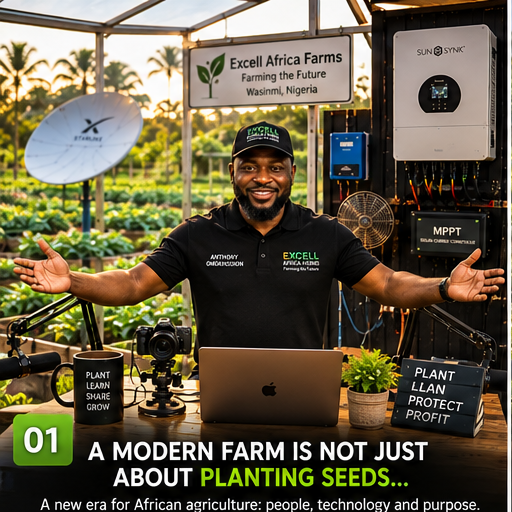
I founded Excell Africa Farms with a growing understanding that productive land can perform several functions simultaneously.
A farm can produce food. It can produce income. It can provide exercise. It can become a place of learning. It can create employment. It can reconnect families with the land. And, perhaps most importantly, it can give its owner a reason to get up tomorrow morning.
Imagine exchanging part of the daily commute for a morning walk through your own farm.
You inspect the plantain. You check the pineapples. You see what is happening with the poultry. You harvest vegetables for lunch. You discover that something has gone wrong in the greenhouse and spend the morning figuring out why.
Tomorrow brings another problem — and another opportunity.
That isn’t necessarily retirement from life. It may be the beginning of an entirely different life.
But Don’t Romanticise Farming
There is an important warning here.
Buying land is not the same thing as owning a productive farm.
A farm can consume retirement savings just as easily as it can generate income.
Poor management, unsuitable land, theft, unreliable labour, inappropriate livestock, weak markets, excessive infrastructure spending and simply growing something because everybody else is growing it can turn the retirement dream into an expensive nightmare.
I know this because farming teaches its lessons in the real world.
So I am not suggesting that someone approaching retirement should withdraw their pension, buy ten acres and suddenly declare themselves a farmer.
Quite the opposite.
Start learning before you retire.
Start small. Experiment. Understand your market. Build your infrastructure gradually. Discover what you actually enjoy doing. And wherever possible, create several complementary activities rather than depending upon one crop or one animal.
The Modern Retirement Farm
There is another misconception worth challenging.
Retirement farming does not have to mean spending eight hours every day under the African sun with a hoe and cutlass.
The modern farm can look very different.
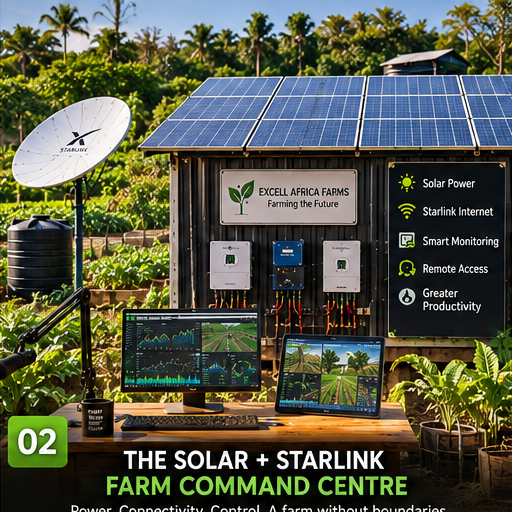
Solar power can provide energy. Irrigation can reduce manual watering. Greenhouses and protected growing can improve control. Hydroponics and vertical systems can increase production from relatively small spaces. Cameras can improve security. Sensors can monitor conditions. Artificial intelligence can assist with planning, diagnosis, record keeping, research and marketing.
And the internet means that the knowledge generated on the farm can itself become valuable.
A retired accountant might run a farm while teaching farm bookkeeping. A retired engineer might develop low-cost irrigation systems. A retired teacher might establish agricultural training programmes. A retired nurse might specialise in nutrition and food production. A retired businessperson might concentrate on processing, packaging and distribution rather than doing most of the physical farming.
Your previous career does not have to end when farming begins.
The farm can become the laboratory in which forty years of accumulated knowledge finds a new purpose.
From Pension to Productive Asset
This changes the retirement equation.
Traditionally, retirement planning is largely about accumulating enough assets during our working years to finance consumption during the years when we no longer work.
But imagine adding a productive asset to that equation.
A carefully developed farm could potentially produce food for the household while creating commercial opportunities from crops, livestock, processing, training, agro-tourism, agricultural services or other activities.
Not every activity will succeed. Not every farm will be profitable. Farming carries genuine financial and operational risks.
That is precisely why the planning should begin before retirement, not afterwards.
The objective should not be to gamble the pension on agriculture. It should be to build a productive system gradually enough that, by retirement, you already understand how it works.
Perhaps We Need to Redefine Retirement
I am increasingly uncomfortable with the idea that reaching a certain age means our most productive years must be behind us.
Experience has value. Networks have value. Knowledge has value. Time has value.
And retirement can finally provide something many people lacked throughout their working lives: greater control over that time.
So perhaps the objective isn’t simply to retire. Perhaps it is to re-purpose.
At Excell Africa Farms, this is part of what we are exploring: agriculture not merely as primary production, but as the meeting point of food, technology, enterprise, education, health and generational legacy.
And you don’t necessarily need one hundred acres.
For some people, the appropriate beginning might be ten acres. For somebody else, one acre. For another person, it could be a greenhouse, an orchard, a poultry unit or a productive garden.
The important question isn’t simply: How much land can I buy?
It is: What productive system can I build, learn to manage and sustain?
Start Before the Retirement Party
If retirement is five or ten years away, perhaps now is precisely the time to start.
Not with a huge investment. Start with education. Visit working farms. Grow something. Test a small enterprise. Learn about processing and markets. Find out whether the romantic picture in your head survives contact with real agriculture.
And build gradually.
By the time the retirement party arrives, you may discover that you aren’t retiring from something at all. You are graduating into something else.
Your pension may help pay the bills. Your farm could potentially produce food, enterprise, activity, knowledge and legacy.
And perhaps that is a much richer definition of retirement.
So I will leave you with one question:
As you prepare for retirement, are you preparing merely to stop working — or are you preparing to start living differently?
Continue the Journey
At Excell Africa Farms, we are documenting the successes, failures, experiments and lessons involved in building a modern African farm — from conventional production to greenhouse growing, livestock, processing, renewable energy, AI and agricultural education.
Follow the journey at ExcellAfricaFarm.com.
And keep learning with us here on JustLearn.online, where one practical question can become the beginning of an entirely new enterprise.
Your Farm is Your Farmacy.