There is a small ritual repeated in millions of African kitchens every day.
The soup is simmering. In goes a stock cube. Perhaps another. The meat may already have been seasoned separately. More seasoning powder goes into the stew. Then somebody tastes the pot and reaches for the salt.
Nothing about this seems unusual. And that is precisely why it deserves a place in our What’s Really On Your Plate? conversation.
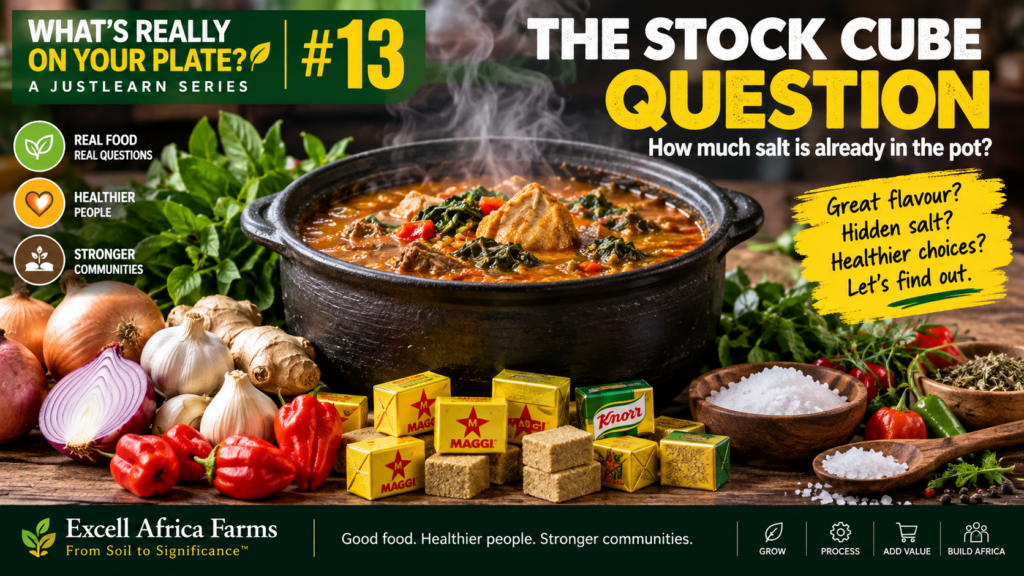
How much sodium is already in the pot?
Today’s question is not whether stock cubes are simply “good” or “bad”. That is too simplistic. The more useful question is: how much sodium has already entered the pot before we add the salt?
Salt is not the enemy
Our bodies need sodium. It plays important roles in nerve and muscle function and in maintaining fluid balance. The issue is quantity. The World Health Organization recommends that adults consume less than 2,000 mg of sodium per day, equivalent to less than 5 grams of salt.
But we do not consume sodium only from the salt shaker. It can already be present in bread, processed meats, sauces, packaged foods, seasoning powders and stock cubes. So counting teaspoons of added salt does not necessarily tell us how much sodium we are consuming.
The disappearing cube
Stock cubes are particularly interesting because they disappear. Drop one into a bubbling pot and, seconds later, it is gone. Drop another in and that disappears too. By the time dinner reaches the table, nobody sees three stock cubes sitting beside their portion. We simply taste the result.
That makes this a perfect example of the philosophy behind What’s Really On Your Plate? Sometimes what matters about our food is precisely what we cannot see.
Do not throw away the African kitchen
Health discussions about African food can quickly become conversations about everything we supposedly need to stop eating: no palm oil, no swallow, no traditional soup, no meat. Eventually we are left wondering whether eating more thoughtfully means abandoning the foods we grew up with.
At Excell Africa Farms, we are interested in a different question: can we make the food we already love better?
What if flavour started in the field?
Consider what gives African cooking its extraordinary depth: onions, garlic, ginger, fresh peppers, crayfish, scent leaf, bitter leaf, fermented ingredients, seeds, spices and fresh or dried herbs.
These ingredients create aroma, complexity, heat, bitterness, sweetness and layers of flavour. If more flavour comes from the ingredients themselves, perhaps we do not always need quite as much flavour to come from salt-heavy seasonings.
This is not about declaring one ingredient good and another bad. It is about proportion. Perhaps two cubes become one. Perhaps salt is not added automatically. Perhaps we taste first. Perhaps herbs and spices do more of the work.
From the farm to the seasoning cupboard
At Excell Africa Farms, we grow plants including scent leaf, moringa and lemongrass, and we have been experimenting with drying and processing some of what we grow. That creates a fascinating connection between farming and the kitchen.
What if African farms did not simply produce raw crops? What if they also helped rediscover and develop flavour combinations built around locally grown herbs, vegetables and spices?
Instead of asking only, “What seasoning should I buy?”, we can also ask: what flavour can we grow?
Read the label
There is a simple experiment you can try the next time you shop. Pick up the stock cubes or seasoning powder you normally buy. Turn the packet over. Find the nutritional information and look for salt or sodium. Then check the serving size.
You may be surprised by how small the manufacturer’s stated serving is compared with the amount actually used in a family pot. Do not panic about the number. Just become aware of it.
That is what this series is about: not fear, not food shaming, but awareness.
Your food has a history
How was our food grown? How was the animal raised? What happened during processing? What was sprayed on the crop? How does our individual digestive system respond? How much oil went into the meal? How large is the portion? And now: how much seasoning went into the pot?
None of these questions alone tells us whether a meal is healthy. Together, however, they tell us something important: food has a history.
Your dinner did not begin when somebody placed the plate in front of you. It began much earlier: in the soil, on the farm, during processing, in the shop, in the seasoning cupboard and finally in the kitchen.
Tonight, count the cubes
Do not change anything yet. Cook exactly as you normally would. But this time, count. How many stock cubes went into the meat? How many went into the soup? Was seasoning powder added too? Was salt added afterwards?
Could I get the same delicious result with a little less next time?
Perhaps the answer is no. Perhaps it is yes. But now you are thinking about it. And that is where change begins.
What’s Really On Your Plate?
The answer is not simply chicken, rice, soup, yam or vegetables. There is an entire agricultural and culinary story sitting on that plate.
We intend to keep asking questions about it — not because African food needs to be replaced, but because understanding our food better may help us preserve the best of it while improving the rest.
Excell Africa Farms
From Soil to Significance™
Continue the journey from plate back to farm
Next time you cook, count the stock cubes and seasonings before they disappear. Then keep following the evidence behind the food. Read Rice, Plantain and a Private Jetty to see how food production, land and enterprise connect at Excell Africa Farms, and explore our other farm experiments in the JustLearn Articles library.
If you are a farmer, food processor or entrepreneur, carry one question with you: what flavours could Africa be growing, processing and selling instead?